Part-1: Storm Chaser. Part-2: Traveling Surveyor.
The Forgotten Holocaust
When the Nazi death camps in Europe were discovered by the allied forces toward the end of WW2, General Eisenhower ensured that many people, including allied troops as well as local civilians got a good look at those concentration camps, and had the evidence documented for posterity. Today, after more than six decades, the belief that the Jewish holocaust actually happened (with a probability of 1.0) is accepted by most of the world. A key step in such situations is to record as much evidence, and obtain multiple and independent verification of events in a scientific and unbiased manner, when the relevant facts still have a fresh time-stamp and eye witnesses are alive and willing to go on the record.
While the Jewish population, and others in Europe were being cleansed from the world of the fictional master-race of Aryans (another byproduct of the discredited Aryan Invasion Theory (AIT), which was initially concocted by a few 19th century German researchers analyzing Sanskrit texts, and later 'weaponized' by the British Raj for empire building), occupied Bengal in India was dying of starvation and disease. Some historians have attributed the deaths of these 3-6 million innocent Bengalis in the 1940s to the British occupation policy - one that was inspired by the very same AIT that the Nazis whom they were fighting, also subscribed to. However, there was neither an Eisenhower nor his resources to allow an exhaustive audio-video-text recording of the facts surrounding this tragedy in Bengal. Millions of innocent Indians were claimed by that holocaust 70 years ago, and much of the world knows very little about it.
Let's look at the data.
The Bengal of Mahalanobis, 1943
The British empire's occupation model ensured the conversion of India from a thriving
manufacturing and knowledge hub into an agrarian, subsistence economy. India turned into a supplier of slave-wage labor as well as a market for
Britain's finished goods. If this wasn't enough, the empire monopolized the mother-of-all drug running operations whose supply chain originated in Bengal. Bengal's native economy
was badly dented when the second world war arrived.
An old map of India (possibly) in the 1940s. Bengal is situated in the eastern part of India.
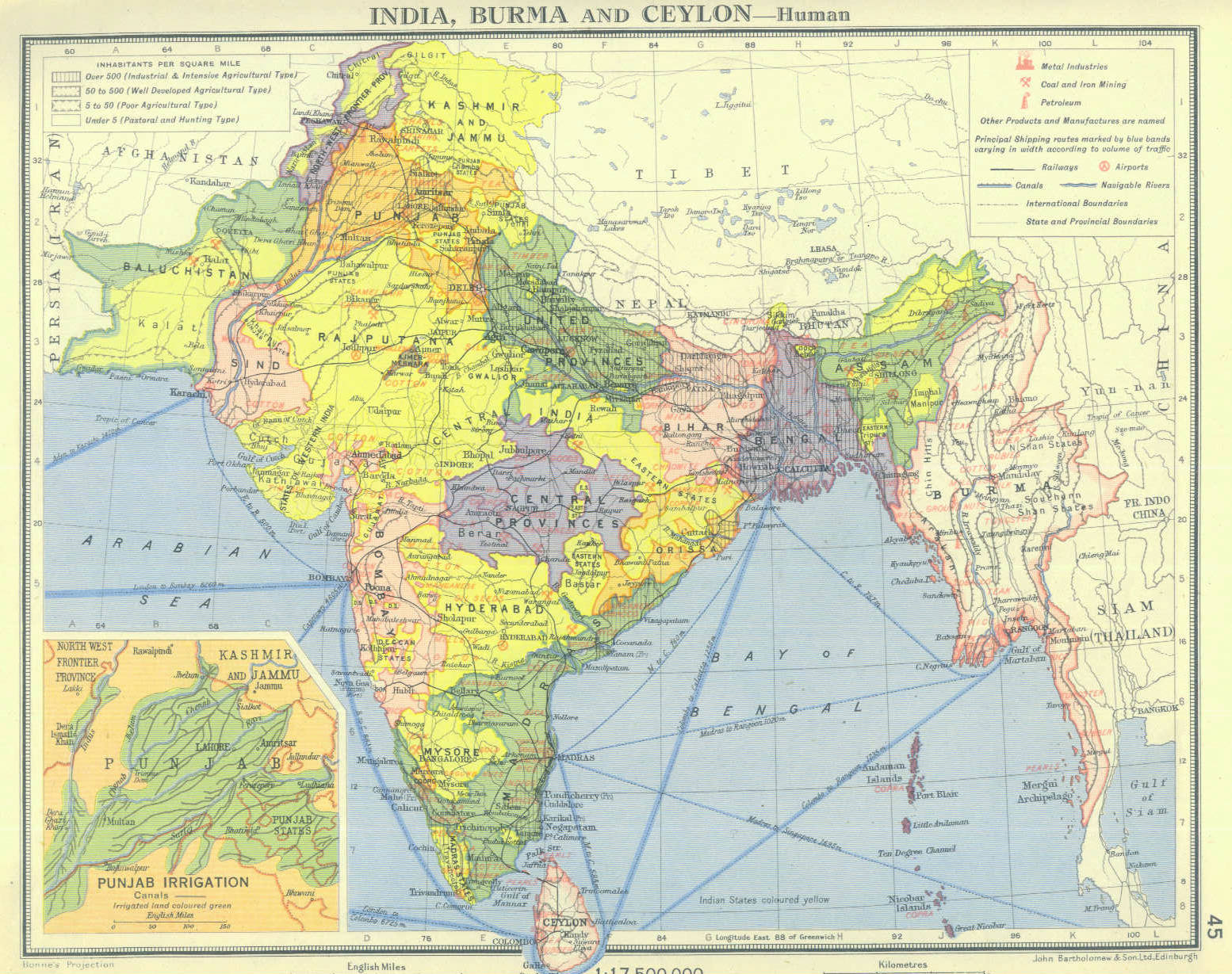
(pic source link: gypsyscholar.com)
Mahalanobis had just published reports of his pioneering work on optimized random sampling to estimate the Jute crop in Bengal (an effort that ranks among the earliest victories for the field of Operations Research). A reading of his research papers point to a person who was a dispassionate collector of data and details, a stubbornly methodical person (his detailed breakdown of costs incurred during the jute crop sampling optimization project is mind-boggling), and a person who was enthusiastic about, and skilled in the application of analytics to solving real problems.
Mahalanobis was requested by a representative of the occupied people to do something to bring to light the facts surrounding the Bengal holocaust. Thus it transpired that a Operations Researcher / Applied Statistician, and not some military general, was entrusted with the job of recording the facts of the Bengal holocaust that occurred between 1942-1944.
An increasing number of historians today are coming around to the view (including many blogs) that was held by many in Bengal - that this crisis was an inevitable outcome of British Raj policy. Going one step further, Madhushree Mukerjee has painstakingly compiled evidence and data that implicates the British Raj and the one person she felt was most responsible: Winston Churchill, in her recent book "Churchill's Secret War". The evidence is disturbing, and readers can make up their own minds.
(pic source link: http://www.marymartin.com)
The focus of this post is not on Churchill but to try and grasp the estimated scale and dimensions of the tragedy brought to light by the systematic findings of Mahalanobis' randomized survey.
The work of Mahalanobis
Mahalanobis applied for and obtained a grant from the Government after a considerable delay to conduct his analysis. Time was of the essence, and he again employed his cost-effective yet accurate methods based on random sampling (an overview is provided in part-2 of this series) by interviewing families located in different locations within Bengal. Approximately 16, 000 randomly
selected families from 386 villages were surveyed between July 1944 and
February 1945. Detailed statistics including: loss of life in the family by age and gender, the mortgaging and/or sales,
either in part or full, of farm land, as well as the sale of cattle
used to plough the
land, their profession, economic status, etc. were collected. Bengal was divided into regions, classified based on the degree to which they affected by the famine. The survey design took this into account and weighted averages were calculated to avoid over- or under-reporting of mortality rates.
Official
forecasts of food supply and demand were of pretty poor quality and 'bad guesswork' as mentioned in the prior post, and unreliable. The survey report noted
that Bengal was suffering from food inventory deficit well before
the crisis of 1943: The net annual import was 100K tons on average, and up to a million and half tons during individual years, during the seven year period between 1933-39, i.e., even before WW2 started, from which point it could have only gotten worse. Data also showed that the pre-1943 rate of land sales was rising in a
land where the primary occupation was agriculture and 76% of
the family-owned farm land was already at or below the subsistence level. A good proportion of the cattle that was sold was not repurchased by native farmers but by outsiders (possibly for slaughter to supply meat to military personnel). All indicators pointed to an already desperate situation that also left Bengal totally vulnerable to any supply-demand shock, which inevitably arrives sooner or later. In this case, the supply shocks arrived in the form of imperial Japanese troops storming Burma (today's Myanmar), and the apparent failure of
rice crop. Demand (and hence price) spikes cannot be ruled out either.
1943 was apocalyptic for Bengal. The Mahalanobis report measured the change in the already terrible economic indicators, as well as the increase in the number of destitutes. These numbers are shocking and point to the total absence of effective government intervention: A 300% increase in economic deterioration and 1200% increase in the rate of destitution (with young women affected the most) during the famine even as Britain appeared to stockpile food for itself. Bengal was a victim of depraved indifference of the worst kind.
(picture source link: boydom.com)
Fatalities
The sampling survey attempted to obtain the number of family members who had lost their lives during the food shortage. Mahalanobis estimated a mortality rate of 5.0% for men and 5.6% for women in a estimated 1943 population of around 61 Million (derived from a 1941 census). By design, the survey excluded: infant and toddler deaths, individuals without families, and entire families that either perished or relocated out of Bengal. Mahalanobis was not provided funds to repeat this sample survey ever again, so the fatalities in 1944 could not estimated.
The next step was to establish a counter-factual: what would have been the 'normal' mortality rate had the disaster not taken place? He chose 1931 as the baseline year, since data was available. That rate was 4.0%. Madhusree's book notes that the normal mortality rate for India then was 2.1%, so Bengal's
1931 rate was already nearly double that number - a stunning statistic. Note that a different counterfactual will give us a different 'missing number' value.
Note: This post does not provide numbers from Amartya Sen's analysis because his numerical results have been shown to be shaky in multiple instances upon further examination (see this old dualnoise post for example, as well as external references 1, and 2).
Some of the reasonable numbers quoted by historians today are derived from Mahalanobis' carefully-designed and controlled sampling study. For example, Madhusree, after correcting for infant deaths, and noting the symmetrical distribution of mortality rates around December 1943, arrived at an estimate of 3 million incremental deaths during 1943-44. The total number of incremental fatalities across the war years is likely to be higher and comes eerily close to the number of Jews murdered in Europe by the Nazis. Also, if the reference counterfactual is taken as India's normal mortality rate (2.1%) to include the abnormal situation in Bengal during those years, this number further shoots up. Birth rates in 1943-44 dropped significantly as well. Based on these calculations, it is plausible that Bengal lost around 10% of its population during the war years.
The random sampling methodology for estimating the supply of jute that earned much revenue for Bengal, and for determining food crop produce that fed it was eventually re-used to estimate the number of Bengalis who died without having anything more left to sell or eat. Mahalanobis' carefully chosen words within his final summation reads:
"... The famine of 1943 was thus not an accident like an earthquake or a flood, but the culmination of economic changes that were going on even in normal times."
Postscript
A remarkable finding about the millions of Indians who were left to starve to death in Bengal: there was no cannibalism anywhere.
Selected References
1. Several Sankhya journal articles of the 1930s-40s that cover the relevant works done in the ISI including:
'Mortality in Bengal in 1943'
'The Bengal Famine' - reprinted from 'The Asiatic Review', 1946.
'Report on the Bengal Crop Survey, 1944-45'
'The Sample Census of the Area Under Jute in Bengal in 1940'
'An Estimate of the Rural Indebtedness of Bengal', 1934
'Elasticity of Wheat in 1935 India'
'Indian Statistical Institute: Numbers and Beyond, 1931–47'
2. Madhusree Mukerjee, "Churchill's secret war', pages: 266-273
3. http://www.bowbrick.org.uk/Famine%20pages/famine.htm. Also see the 'key documents on the famine' page.
4. The New York Review of Books: "Did Churchill let them starve?", and the resultant exchange with Amartya Sen.
5. Madhusree's interview at harpers.org.
Updated June 29: mildly edited for brevity.
Showing posts with label Counterfactual. Show all posts
Thursday, June 27, 2013
Thursday, December 13, 2012
Analytics and Cricket - X : Reader's Response to DRS Debate
It's getting increasingly difficult to post on cricket given that the Indian cricket team is getting ripped to shreds by half-decent opposition despite home-ground advantage. Of course, as noted in an
earlier post,
home courts can significantly increase the chance of a choke, and this may well be happening. Mahendra Singh Dhoni (if
by some chance, still remains the captain of the Indian team
after the current cricket series) can win a few more tosses if he can exploit this idea. Desperate times call for analytical measures!
Meanwhile, an astute reader emailed a detailed response to the Bayes-theorem based analysis of the Decision Review System (DRS) used in cricket, which was posted on this blog a few months ago. He made some very pertinent points along with some brilliant comments on the game, which led to an informative exchange that will be carried in the next couple of cricket-related posts. Here is our the 2x2 color coded DRS matrix again for reference.
Raghavan notes:
".... I must question some of the steps in your analysis:
1. In your derivation you use P(RED|OUT) = 0.95. I think this is true only if all decisions are left to DRS. You have considered only those decisions that are deemed not out by the umpire and referred. The 95% number does not hold for these selected cases. It would be lower. Here's the rationale:
There is a high degree of correlation between DRS and umpires decisions; understandably so, since all those "plumb" decisions are easy for both, the umpire and DRS. Bowlers would rarely review these decisions. For the 10% or so cases when the umpire rules the batsman not out incorrectly, the DRS would very likely have a lower accuracy than its overall 95%.
2. If you assume the "red zone" in the picture is sufficiently small compared to 10%, you would get the accuracy of DRS being about 50% for the cases when the umpire incorrectly rules not out. Now, this needs a bit of explanation.
Let's assume that whenever the umpire rules out correctly, the DRS also rules correctly (well, at least close to 100% of the time). Note that this does not include just the referrals, but also all the "easy and obvious" decisions that are not referred. Since the overall accuracy of DRS is 95%, of the 10% that the umpire incorrectly rules not out, DRS also gets it wrong for half of those 10% cases giving an overall 95% accuracy. In case the "red zone" corresponding to incorrect OUT decisions of the DRS is not close to zero, but say 2% (which is large in my opinion), the DRS accuracy in the bowler referred cases we are talking of would by 70% rather than 50%. Still way lower than the 95% overall accuracy. [I have made some approximations here, but the overall logic hold]
3. Now, if you plug 70% instead of 95% in your next steps, you get P(OUT|RED) = 88.6%. Nothing wrong with this number, except when you compare it with the 90% accuracy of umpires. It's not apples to apples. P(OUT|Umpire says OUT) is not 90% if you only considered referred cases. It's actually a conditional probability:
P(OUT|Umpire says OUT, BOWLER REFERS). I don't have enough information to estimate this, but I'm sure you'll agree it's lower than 90% since bowlers don't refer randomly.
4. I think the right comparison is between the what the final decision would be with and without DRS. There is no doubt that umpire + DRS referrals improve overall accuracy of decisions. I admit that false positives would increase marginally, which affects batsmen more than bowlers because of the nature of the game (a batsman has no chance of a comeback after a bad decision, while a bowler does). But I think it is because of the way Hawk-eye is used today.
5. In my opinion, the main problem with DRS is that its decision are made to be black and white. There should be a reliability measure used. A very rudimentary form of this currently used in LBW decisions. For example, if the umpire has ruled out, to be ruled not out by DRS the predicted ball path has to completely miss the stumps. But if the umpire has ruled not out, the predicted path should show that at least half the ball is within the stumps for the decision to be over-turned. Eventually, I feel Hawk eye would be able to estimate the accuracy of it's decision. I'm sure Hawk eye has statistics on it's estimates. The standard deviation of the estimate would depend on several factors - (1) how far in from of the stumps has the ball struck the pads (2) How close to the pads has the ball pitched (hawk-eye needs at least a couple of feet after the bounce to track the changed trajectory), (3) Amount of turn, swing or seam movement observed.
If a standard deviation (sigma) can be estimated, then a window of say +/- 3*sigma could be used as the "region of uncertainty". If the ball is predicted to hit the stumps within this region of uncertainty then the decision should be out. Of course the more complicated it gets to explain to the viewer, the more resistance there would be to be accepted. But if it is the right way, it will eventually get accepted. Take DL method for example. A vast majority of viewers don't understand it fully, but most of them know that it is fair.
6. There's another aspect that needs to be investigated. It's about how the decision of the on-field umpire is affected by the knowledge that DRS is available. "
Followups will be carried in a subsequent post. Blog-related emails can be sent to: dual[no space or dot here]noise AT gmail dot com, or simply send a tweet.
Meanwhile, an astute reader emailed a detailed response to the Bayes-theorem based analysis of the Decision Review System (DRS) used in cricket, which was posted on this blog a few months ago. He made some very pertinent points along with some brilliant comments on the game, which led to an informative exchange that will be carried in the next couple of cricket-related posts. Here is our the 2x2 color coded DRS matrix again for reference.
Raghavan notes:
".... I must question some of the steps in your analysis:
1. In your derivation you use P(RED|OUT) = 0.95. I think this is true only if all decisions are left to DRS. You have considered only those decisions that are deemed not out by the umpire and referred. The 95% number does not hold for these selected cases. It would be lower. Here's the rationale:
There is a high degree of correlation between DRS and umpires decisions; understandably so, since all those "plumb" decisions are easy for both, the umpire and DRS. Bowlers would rarely review these decisions. For the 10% or so cases when the umpire rules the batsman not out incorrectly, the DRS would very likely have a lower accuracy than its overall 95%.
2. If you assume the "red zone" in the picture is sufficiently small compared to 10%, you would get the accuracy of DRS being about 50% for the cases when the umpire incorrectly rules not out. Now, this needs a bit of explanation.
Let's assume that whenever the umpire rules out correctly, the DRS also rules correctly (well, at least close to 100% of the time). Note that this does not include just the referrals, but also all the "easy and obvious" decisions that are not referred. Since the overall accuracy of DRS is 95%, of the 10% that the umpire incorrectly rules not out, DRS also gets it wrong for half of those 10% cases giving an overall 95% accuracy. In case the "red zone" corresponding to incorrect OUT decisions of the DRS is not close to zero, but say 2% (which is large in my opinion), the DRS accuracy in the bowler referred cases we are talking of would by 70% rather than 50%. Still way lower than the 95% overall accuracy. [I have made some approximations here, but the overall logic hold]
3. Now, if you plug 70% instead of 95% in your next steps, you get P(OUT|RED) = 88.6%. Nothing wrong with this number, except when you compare it with the 90% accuracy of umpires. It's not apples to apples. P(OUT|Umpire says OUT) is not 90% if you only considered referred cases. It's actually a conditional probability:
P(OUT|Umpire says OUT, BOWLER REFERS). I don't have enough information to estimate this, but I'm sure you'll agree it's lower than 90% since bowlers don't refer randomly.
4. I think the right comparison is between the what the final decision would be with and without DRS. There is no doubt that umpire + DRS referrals improve overall accuracy of decisions. I admit that false positives would increase marginally, which affects batsmen more than bowlers because of the nature of the game (a batsman has no chance of a comeback after a bad decision, while a bowler does). But I think it is because of the way Hawk-eye is used today.
5. In my opinion, the main problem with DRS is that its decision are made to be black and white. There should be a reliability measure used. A very rudimentary form of this currently used in LBW decisions. For example, if the umpire has ruled out, to be ruled not out by DRS the predicted ball path has to completely miss the stumps. But if the umpire has ruled not out, the predicted path should show that at least half the ball is within the stumps for the decision to be over-turned. Eventually, I feel Hawk eye would be able to estimate the accuracy of it's decision. I'm sure Hawk eye has statistics on it's estimates. The standard deviation of the estimate would depend on several factors - (1) how far in from of the stumps has the ball struck the pads (2) How close to the pads has the ball pitched (hawk-eye needs at least a couple of feet after the bounce to track the changed trajectory), (3) Amount of turn, swing or seam movement observed.
If a standard deviation (sigma) can be estimated, then a window of say +/- 3*sigma could be used as the "region of uncertainty". If the ball is predicted to hit the stumps within this region of uncertainty then the decision should be out. Of course the more complicated it gets to explain to the viewer, the more resistance there would be to be accepted. But if it is the right way, it will eventually get accepted. Take DL method for example. A vast majority of viewers don't understand it fully, but most of them know that it is fair.
6. There's another aspect that needs to be investigated. It's about how the decision of the on-field umpire is affected by the knowledge that DRS is available. "
Followups will be carried in a subsequent post. Blog-related emails can be sent to: dual[no space or dot here]noise AT gmail dot com, or simply send a tweet.
Monday, March 26, 2012
Gender-Shaping III: Is Amartya Sen's Missing Women Count Exaggerated?
This is the third post in this series on gender-shaping. The previous installment can be found here. Thanks to a twitter link, I came across a 2010 journal paper: "Missing Women: Age and Disease," Siwan Anderson (University of British Columbia) and Debraj Ray (New York University) published in Review of Economic Studies Vol.77.
This paper has among other things, investigated Amartya Sen's '100 Million Missing Women of India' claim that is attributed to systemic discrimination. Anderson and Ray have estimated the number of 'missing women' in India, China and Sub-Sahara Africa by age and cause-of-death (not done before) while also moving away from the simplistic aggregate sex ratios that were used as baselines in prior works. The authors make the following useful observations: Defining missing women by differences in aggregate sex ratios can be misleading, or uninformative (or both). It is misleading because different countries have different fertility and death rates, and (in particular) different age distributions. They will have different disease compositions.
They may also have different sex ratios at birth for genetic or environmental reasons that have nothing to do with missing females.
The procedure is also uninformative: we cannot tell at what ages the missing women are clustered, or what diseases are responsible. Thus, we cannot begin to ask about the various
channels: discrimination, biology, social norms, and so on. Answering these questions is of profound importance. By unpacking missing women by age and disease, our paper takes a limited and preliminary step in this direction."
From an OR perspective, we extensively rely on similar customer segmentation models (in revenue management for e.g), and this additional age- and causal-factor based segmentation appears to be quite important and yields two main results as well as a comparative result that may be interesting to an U.S audience:
1. A large fraction of the missing women in India are not infants (less than 20%) but adults, and is attributable to other factors like disease and injury, apart from any systemic discrimination. Consequently, any claim of exclusively female infanticide driven 'missing women' in India is rejected. On the other hand, this paper finds that 44% of China's missing women are in the prenatal age-group. Here is a snapshot of sex-ratio by age, taken from the Anderson & Ray paper:
2.The authors make an interesting comparative comparison with the U.S: "we observe some similarities between age-specific percentages of missing women in the historical United States (ca. 1900) and India or sub-Saharan Africa today".
3. The Sen count (100 million missing women) appears to have been calculated with respect to a specific counterfactual: The overall sex ratio for N. America, U.S and Japan. An alternative calculation by Coale (1991) comes up with a more conservative estimate of 60 million. Anderson and Ray perform similar calculations but at the segment level (i.e. by age-disease) and generate missing number estimates using more carefully chosen counterfactuals as the baseline and find approximately 20 million missing women in India (aggregated across all age groups), while the corresponding figure for China is 58 million. Furthermore, 'injury' is not an insignificant culprit in India across all age groups, a potentially worrying trend that its government must look into. (The paper alludes to the old bogey of 'dowry deaths' as a probable cause which may not turn out to be the case. A similar detailed analysis is required).
The findings of this paper also weakens a statement in a previous post on this topic that a skewed overall male:female ratio in a region is a 'scary indicator' of female infanticide being practiced there. My statement ignored the age distribution as well as the 'cause of death' dimension. Bad O.R, but I have Amartya Sen for company.
Subscribe to:
Comments (Atom)
