LPHC Events
The importance of modeling Low-Probability High Consequence (LPHC) events, popularized in recent times by Nassim Taleb as "Black Swans" has been recognized by Operations Researchers for quite some time. As this recent article
(via Reddit) implies, it is both demystifying and useful to talk of consequential rare
events in terms of a range of probabilities rather than a
potentially misleading binary classification of B/W Swans. For example, LPHC modeling is critical to identifying min-risk Hazmat routes, a popular research area within OR. In addition to standard risk measures such as the expected probability of an accident occurring on a given route, or the total expected cost of a chosen route, planners also explicitly limit the conditional expected cost associated with a catastrophic event along a prescribed route if in fact such an event were to occur along any link in the route. Practical OR models aim for robustness by never focusing on just one objective given that extremal solutions tend to faithfully follow the no-free-lunch rule. OR Planners typically track a variety of risk objectives and seek alternative optimal solutions that adequately address the multiple modes of failure that can be triggered over time.
Narrative-Rational, Time-Dependent World
Until recently, I thought that coin tosses were 50-50 events. In an unbiased, narrative-free world they are, but as Venkatesh Rao argues in his book 'Tempo' (and this understanding is subject to my limited ability to grasp and interpret the dense writing style employed in this book) that there is no absolutely narrative-independent useful model of rational decision-making: "... there is no meaningful way to talk about specific decisions outside of a narrative frame and a concrete context, any more than it is possible to talk about physics without reference to a specific, physical coordinate frame ..."
Rao agrees with Taleb's 'Black Swan' book claim that introducing a narrative injects bias, but is disinclined to adopt the approach of severing the narrative from the decision making process. Instead, Rao chooses to embrace narrative and his book examines elegant and sound decision-making within a given enactment over the narrative clock. On the other hand, Venkatesh Rao feels that the narrative-independent "Calculative rational decision-making finesses situatedness by working only with highly controlled clocks. When you start this way, seductive general theories of decision-making take center stage, and local conditions are forgotten, minimized or dismissed as “details.”. Perhaps, by zooming in on the narrative of a guy who makes decisions
based on the outcome of 'vigorously tossing and catch a coin',
researchers were able to recognize these subtle 'local conditions' that allowed them to predict the bias in real-life coin tosses.
Risk and Analytics
How do we deal with risk associated with decisions prescribed by today's predictive analytical models embedded within decision support systems? This is an important issue since our underlying predictive analytical models are calibrated using noisy data generated from past decisions. As long as our recommendations lie within the historical range, its consequences can be expected to be reasonably bounded. However, once we create new history (e.g. pricing a product at a value never ever done before), our predictive model is forced to extrapolate. Per 'Tempo', we now exit a closed world and enter an open one, where "The open world is a world that includes what Donald Rumsfeld called “unknown unknowns” and Nicholas Nassim Taleb calls “black swans” (rare, highly consequential events)." In such instances, history is of limited use as a guide, and statistically driven analytics can fail. Rao says that such calculative rational [analytical models]: "... can be viewed as a way of systematically leveraging or amplifying intuition. But intuition amplified through calculative-rational models, while necessary, is not sufficient for true risk management.".
Welcome to Entropic Decision Optimization
One option to survive the open world is to have in place a theoretical model that anticipates the consequences of such unforeseen events. 'Tempo' suggests that "Informal human mental models can comprehend open
worlds because they can contain things that haven’t been understood: a
high entropy state." Although Rao rightly suggests that analytical methods for such weakly understood "high entropy" situations are in its infancy, having even a simple and reasonable model helps. For example, in a recently patented pricing optimization method, we attempt to reduce a user-specified measure of 'entropy' (in the form of business disruption) associated with recommendations, which has worked reasonably well within a retail narrative so far. However, in the narrative-rational world of 'Tempo', the laws of thermodynamics dictate that all good things must come to an end regardless of whether we encounter a black swan or not. A simple "Frankenstein design principle" that we discussed a couple of years ago suggests that the design of particularly complex systems should explicitly assume a failure at some point in time. 'Tempo' chooses the example of 'Tetris' (rather than Blackjack/Poker, that analytics folks more commonly use) to illustrate that we can maximally delay the inevitable by chalking up elegant but temporary wins via better entropic decision making. A time-knapsack, if you will.
Showing posts with label combinatorial risk. Show all posts
Showing posts with label combinatorial risk. Show all posts
Sunday, December 2, 2012

Monday, November 12, 2012
Operation Red Lotus and Jules Verne
Around the World in 80 Days
One of the few positive side effects of Hurricane Sandy knocking out power for nearly a week was the rediscovery of a childhood joy of reading history books and stories of valiant Indian queens and kings by the candlelight. Globe-trotting dreams of kids in 1970s socialist India who couldn't afford to set foot on an airplane were kindled by reading and re-reading stories like Jules Verne's fascinating adventure travelogue 'Around the World in 80 Days', a book written a hundred years earlier in 1873.
Indian Rebel
Just a few years before Jules Verne wrote some of his most popular books, the English government was engaged in a bloody, all-out war for economic power in the Indian subcontinent. The rebellion against the colonizers in 19th century India was not just a local mutiny of Sepoys (hired soldiers), and not just an uprising of the peasants; native rulers (Rajas), dashing queens (Ranis), naturalized Indian kings of the dying Mughal dynasty, military leaders, intellectuals, priests, bankers, traders, farmers, ... entire populations participated in the struggle to free India socially, economically, and culturally in what came to be recorded as the first war of Indian Independence fought in 1857. This is one of the many excellent findings recorded in the historical book "Operation Red Lotus" written by Parag Tope, a descendent of Tatya Tope, chief coordinator of the Indian war machine during that time period.
Jules Verne's Captain Nemo of 1870 appears to be a character straight out of this war. A hi-tech sea-faring native prince seeking vengeance against the English, Nemo is not far from reality. Native rulers set up navies that relied on the construction of relatively sophisticated ships to safeguard overseas trade interests that were being overrun by the piracy of the English East India Company (EEIC). This is hardly surprising given that the world's first dockyard was built in India and the maritime prowess of native kings on both sides of the Indian coast is legendary. However, the key battles of the 1857 war were fought inland in Northern India.
Operation Red Lotus

A wealth of information from recently recovered original correspondence to Tatya Tope during this time period appears to have encouraged the writing of this book. This excellent review summarizes the findings. While there is ample evidence to suggest that the strategy and tactics employed by the Indian resistance in 1857 was indicative of a comprehensive and long-term approach, claims of an sustainable war effort cannot be taken seriously (to paraphrase Gen. Omar Bradley) unless it can be shown that there was a feasible logistics solution in place. Operation Red Lotus (ORL) answers this question in the affirmative.

pic source
The Lotus Code: Operations Research and Logistics?
ORL is mainly about how Tatya Tope and other leaders on the Indian side designed a simple and neat supply chain to support the war effort and maintain an army of newly unemployed native soldiers, bereft of any provisioning infrastructure. Tatya's first step, like we do in the corporate world today, was to forecast enterprise-level demand - but he had to do this without tipping off the Red Shirts. Toward this, he exploited the contempt the colonizers had for 'backward' Indian rituals and traditions. Tatya Tope secretively sampled demands at the platoon level using a red-lotus based numerical code. The English were puzzled to see a spate of red lotuses being passed around the garrisons in many cities they controlled and initially attributed it to yet another weird 'blood red' native custom. The number of petals in a red lotus is approximately the same as the number of soldiers in an EEIC platoon.
 (source colorbox.com)
A native soldier who volunteered would pluck a petal and pass the flower on. After all soldiers made their choice, what was left of the flower was sent back to Tatya. By counting the reeds and/or the remaining petals in a returned lotus from a particular geographical location, noting the number of lotus-sampled platoons, and rolling up these estimates to a regimental level, Tatya was able to predict the approximate size of the native army by location. Having this fundamental information at hand, the planners calculated the provisioning required to sustain the war effort in its various stages, and also finalize the line of attack to capture and hold Delhi, the capital, as well as other strategically important cities. The next challenge was to geographically allocate supplies to satisfy this location-specific demand forecast given that the emerging native army did not have the resources or the time to rapidly create and manage their own own supply line. The only viable solution was to outsource this task, which was accomplished via the Chapati (an unleavened Indian bread) code.
The Chapati Code
After the flood of lotuses, the English were bemused to see Chapatis being exchanged by the chiefs of some villages. Alarm bells went off and they managed to intercept Chapatis embedded with lotus seeds.
 (source food fun freak blog)
The English concluded that this was not another strange custom and that the exchange of lotuses and Chapatis was some kind of a secret handshake. Red lotuses weren't found in the hands of villagers, and seeded Chapatis were not found in garrisons. What historians did not fully realize was that the lotus and the Chapati distribution were the code; not merely Boolean flags, but a vector representation of numerical information relating to troop strength and battle plans. We now know that the Indian war planners sent Chapatis to the various villages along a directional chain graph on a Euclidean plane whose source was a major garrison, and the sink was an important military objective.
 [ORL book extract]
The men of the villages that were ready to support the war effort would requisition and stock food grains, and the women of the village would be required to prepare food in quantities proportional to the number of Chapatis they received. The village chief would pass on a similar number of Chapatis to the next village in the designated chain. There is little doubt now that this was a coordinated and planned war to achieve self-rule.
Breaking Down The Supply Chain
When the time was ripe, the sepoys mutinied on the pretext of greased cartridges (immortalized by the legend of Mangal Pandey), catching the EEIC and the Victorian government in England off guard, and the initial phase of the war went against the colonizers. However, once they recognized the logistical method employed by the natives, the reprisals were eerily Nazi-like: swift, decisive and genocidal, and in keeping with a pattern that was repeated a few times before India's political independence in 1947. Villages on these chain graphs that supported the war effort were interdicted. Emergency laws were enacted that essentially gave English officers the license to kill civilians based on suspicion. Large populations, including women and children were wiped out, successfully disrupting the Indian supply chain.
 (source: wikipedia)
 (source columbia.edu)
Once the logistical backbone was broken, it was a matter of time before the colonials won the war. However, it turns out that the war also had some cascading international effects.
Global impact of the 1857 Indian War of Independence
The London government withdrew huge sums of money from their banks and investments, including prominent financial institutions in the U.S, to raise sufficient capital to fund and ship out tens of thousands of fresh troops to India to win the war, while publicly spinning this fiasco as a localized case of mutiny. This behavior did not escape the attention of some Americans who questioned the official version.
.
 [ORL book extract, pages 86-87]
ORL notes another pertinent question that George Train asked: "England says they are short of funds. Where are the hundreds of millions of silver that have been shipped there [India], disturbing the currency of the world?
The withdrawal of such huge sums of money by the English from US banks exacerbated the panic of 1857, and the resultant liquidity problem severely impacted the Northern states in the US besides triggering the world's first ever global economic crisis. Furthermore, the war hit the EEIC-pirated textile goods exported from India to the west, which reacted by sourcing more cotton from the southern US states that was being produced at even cheaper rates using African slave labor, thereby boosting the Confederate economy and morale. Thus, the Anglo-Indian war of 1857 appears to also have had some impact on the subsequent American civil war of 1861-65.
Jules Verne's Phineas Fogg is most likely based on George Train, a remarkable real-life American adventurer-entrepreneur who went around the world a few times, including a round trip in 67 days.
Legacy
It is less known that the Indian resistance achieved a few tangible victories for India in the long term. For brevity, we will have to leave that discussion for another day. India lost the 1857 war but those who resisted genocide became legend; none more so than the heroic young queen, Rani Lakshmi Bai. This coming Monday, November 19 is her birthday. Reading the immortal line in the Hindi poem about her in the candlelight as a kid, and then again a few days ago about her incredible exploits in ORL even as hurricane winds howled outside, never fails to bring a lump to the throat.
"She who gallantly fought a man's battle, was our Queen of Jhansi".
One of the few positive side effects of Hurricane Sandy knocking out power for nearly a week was the rediscovery of a childhood joy of reading history books and stories of valiant Indian queens and kings by the candlelight. Globe-trotting dreams of kids in 1970s socialist India who couldn't afford to set foot on an airplane were kindled by reading and re-reading stories like Jules Verne's fascinating adventure travelogue 'Around the World in 80 Days', a book written a hundred years earlier in 1873.
Indian Rebel
Just a few years before Jules Verne wrote some of his most popular books, the English government was engaged in a bloody, all-out war for economic power in the Indian subcontinent. The rebellion against the colonizers in 19th century India was not just a local mutiny of Sepoys (hired soldiers), and not just an uprising of the peasants; native rulers (Rajas), dashing queens (Ranis), naturalized Indian kings of the dying Mughal dynasty, military leaders, intellectuals, priests, bankers, traders, farmers, ... entire populations participated in the struggle to free India socially, economically, and culturally in what came to be recorded as the first war of Indian Independence fought in 1857. This is one of the many excellent findings recorded in the historical book "Operation Red Lotus" written by Parag Tope, a descendent of Tatya Tope, chief coordinator of the Indian war machine during that time period.
Jules Verne's Captain Nemo of 1870 appears to be a character straight out of this war. A hi-tech sea-faring native prince seeking vengeance against the English, Nemo is not far from reality. Native rulers set up navies that relied on the construction of relatively sophisticated ships to safeguard overseas trade interests that were being overrun by the piracy of the English East India Company (EEIC). This is hardly surprising given that the world's first dockyard was built in India and the maritime prowess of native kings on both sides of the Indian coast is legendary. However, the key battles of the 1857 war were fought inland in Northern India.
Operation Red Lotus
A wealth of information from recently recovered original correspondence to Tatya Tope during this time period appears to have encouraged the writing of this book. This excellent review summarizes the findings. While there is ample evidence to suggest that the strategy and tactics employed by the Indian resistance in 1857 was indicative of a comprehensive and long-term approach, claims of an sustainable war effort cannot be taken seriously (to paraphrase Gen. Omar Bradley) unless it can be shown that there was a feasible logistics solution in place. Operation Red Lotus (ORL) answers this question in the affirmative.
pic source
The Lotus Code: Operations Research and Logistics?
ORL is mainly about how Tatya Tope and other leaders on the Indian side designed a simple and neat supply chain to support the war effort and maintain an army of newly unemployed native soldiers, bereft of any provisioning infrastructure. Tatya's first step, like we do in the corporate world today, was to forecast enterprise-level demand - but he had to do this without tipping off the Red Shirts. Toward this, he exploited the contempt the colonizers had for 'backward' Indian rituals and traditions. Tatya Tope secretively sampled demands at the platoon level using a red-lotus based numerical code. The English were puzzled to see a spate of red lotuses being passed around the garrisons in many cities they controlled and initially attributed it to yet another weird 'blood red' native custom. The number of petals in a red lotus is approximately the same as the number of soldiers in an EEIC platoon.

A native soldier who volunteered would pluck a petal and pass the flower on. After all soldiers made their choice, what was left of the flower was sent back to Tatya. By counting the reeds and/or the remaining petals in a returned lotus from a particular geographical location, noting the number of lotus-sampled platoons, and rolling up these estimates to a regimental level, Tatya was able to predict the approximate size of the native army by location. Having this fundamental information at hand, the planners calculated the provisioning required to sustain the war effort in its various stages, and also finalize the line of attack to capture and hold Delhi, the capital, as well as other strategically important cities. The next challenge was to geographically allocate supplies to satisfy this location-specific demand forecast given that the emerging native army did not have the resources or the time to rapidly create and manage their own own supply line. The only viable solution was to outsource this task, which was accomplished via the Chapati (an unleavened Indian bread) code.
The Chapati Code
After the flood of lotuses, the English were bemused to see Chapatis being exchanged by the chiefs of some villages. Alarm bells went off and they managed to intercept Chapatis embedded with lotus seeds.
The English concluded that this was not another strange custom and that the exchange of lotuses and Chapatis was some kind of a secret handshake. Red lotuses weren't found in the hands of villagers, and seeded Chapatis were not found in garrisons. What historians did not fully realize was that the lotus and the Chapati distribution were the code; not merely Boolean flags, but a vector representation of numerical information relating to troop strength and battle plans. We now know that the Indian war planners sent Chapatis to the various villages along a directional chain graph on a Euclidean plane whose source was a major garrison, and the sink was an important military objective.
The men of the villages that were ready to support the war effort would requisition and stock food grains, and the women of the village would be required to prepare food in quantities proportional to the number of Chapatis they received. The village chief would pass on a similar number of Chapatis to the next village in the designated chain. There is little doubt now that this was a coordinated and planned war to achieve self-rule.
Breaking Down The Supply Chain
When the time was ripe, the sepoys mutinied on the pretext of greased cartridges (immortalized by the legend of Mangal Pandey), catching the EEIC and the Victorian government in England off guard, and the initial phase of the war went against the colonizers. However, once they recognized the logistical method employed by the natives, the reprisals were eerily Nazi-like: swift, decisive and genocidal, and in keeping with a pattern that was repeated a few times before India's political independence in 1947. Villages on these chain graphs that supported the war effort were interdicted. Emergency laws were enacted that essentially gave English officers the license to kill civilians based on suspicion. Large populations, including women and children were wiped out, successfully disrupting the Indian supply chain.
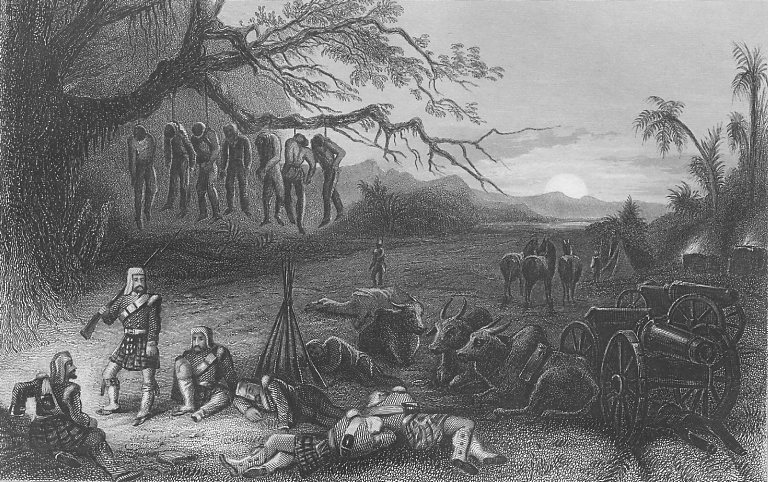
Once the logistical backbone was broken, it was a matter of time before the colonials won the war. However, it turns out that the war also had some cascading international effects.
Global impact of the 1857 Indian War of Independence
The London government withdrew huge sums of money from their banks and investments, including prominent financial institutions in the U.S, to raise sufficient capital to fund and ship out tens of thousands of fresh troops to India to win the war, while publicly spinning this fiasco as a localized case of mutiny. This behavior did not escape the attention of some Americans who questioned the official version.
.
ORL notes another pertinent question that George Train asked: "England says they are short of funds. Where are the hundreds of millions of silver that have been shipped there [India], disturbing the currency of the world?
The withdrawal of such huge sums of money by the English from US banks exacerbated the panic of 1857, and the resultant liquidity problem severely impacted the Northern states in the US besides triggering the world's first ever global economic crisis. Furthermore, the war hit the EEIC-pirated textile goods exported from India to the west, which reacted by sourcing more cotton from the southern US states that was being produced at even cheaper rates using African slave labor, thereby boosting the Confederate economy and morale. Thus, the Anglo-Indian war of 1857 appears to also have had some impact on the subsequent American civil war of 1861-65.
Jules Verne's Phineas Fogg is most likely based on George Train, a remarkable real-life American adventurer-entrepreneur who went around the world a few times, including a round trip in 67 days.
Legacy
It is less known that the Indian resistance achieved a few tangible victories for India in the long term. For brevity, we will have to leave that discussion for another day. India lost the 1857 war but those who resisted genocide became legend; none more so than the heroic young queen, Rani Lakshmi Bai. This coming Monday, November 19 is her birthday. Reading the immortal line in the Hindi poem about her in the candlelight as a kid, and then again a few days ago about her incredible exploits in ORL even as hurricane winds howled outside, never fails to bring a lump to the throat.
खूब लड़ी मर्दानी वह तो झाँसी वाली रानी थी।।
"She who gallantly fought a man's battle, was our Queen of Jhansi".
Thursday, August 2, 2012
Optimal Location of Speed Limit Signs
One of the nice things about the relatively more recent automobile GPS products is that they are able to inform us of the current speed limit. Sometimes, when we take our eyes of the road for a second to grab a soda, we may have driven past a speed limit sign and be unaware of the new speed limit. Of course, there are times when the GPS unit itself does not display the speed limit for certain areas, and at other times, it is off by 10 mph, perhaps due to recent road updates. Like any decision support system, the GPS unit cannot be a fail-safe backup for user negligence.

The problem of optimally locating speed limit signs on a network must have been studied and solved a long time ago especially since the analysis of traffic and transportation networks has long been popular research area among ORMS folks. Perhaps there exists a practical combinatorial optimization problem in terms of determining minimal/safest/least ambiguous ways of locating speed signs in the presence of scarce resources and budget limits. A partial list of assumptions and constraints include:
- Speed limits change in discrete quantities of 5mph or 10 mph
- Every driver will treat the last speed limit sign (or update) they saw on the network as the prevailing speed limit
- Every driver at every point in the road network must be in unanimous agreement on what the speed limit is. This is the ideal situation.
- In practice, perhaps the above requirement can be relaxed to stipulate that any non-trivial ambiguity must be resolved with a certain time or distance threshold whose value is location-specific
- Different types of speed limit signs are possible - they may be time-dependent (day/night) as well as location-dependent (school, bridge, tunnel) - Speed limit values can be fixed or variable ("smart roads"). This requirement can potentially inject a dynamic optimization aspect into the problem.
Perhaps a greedy method may be sufficient to generate a good answer to the (fixed value) speed-limit signpost location problem. There are of course, numerous other related location optimization problems on road networks:
locating advertisement hoardings, direction/information signs, emergency vehicles, detours, etc. All these models appear to be well studied in the literature. The proliferation of smart-phones can also have an impact on future 'smart road network' design in general. All in all, location, location, location science continues to be a very interesting sub-area of Operations Research.


The problem of optimally locating speed limit signs on a network must have been studied and solved a long time ago especially since the analysis of traffic and transportation networks has long been popular research area among ORMS folks. Perhaps there exists a practical combinatorial optimization problem in terms of determining minimal/safest/least ambiguous ways of locating speed signs in the presence of scarce resources and budget limits. A partial list of assumptions and constraints include:
- Speed limits change in discrete quantities of 5mph or 10 mph
- Every driver will treat the last speed limit sign (or update) they saw on the network as the prevailing speed limit
- Every driver at every point in the road network must be in unanimous agreement on what the speed limit is. This is the ideal situation.
- In practice, perhaps the above requirement can be relaxed to stipulate that any non-trivial ambiguity must be resolved with a certain time or distance threshold whose value is location-specific
- Different types of speed limit signs are possible - they may be time-dependent (day/night) as well as location-dependent (school, bridge, tunnel) - Speed limit values can be fixed or variable ("smart roads"). This requirement can potentially inject a dynamic optimization aspect into the problem.
Perhaps a greedy method may be sufficient to generate a good answer to the (fixed value) speed-limit signpost location problem. There are of course, numerous other related location optimization problems on road networks:
locating advertisement hoardings, direction/information signs, emergency vehicles, detours, etc. All these models appear to be well studied in the literature. The proliferation of smart-phones can also have an impact on future 'smart road network' design in general. All in all, location, location, location science continues to be a very interesting sub-area of Operations Research.
Saturday, June 30, 2012
Alternative Optimal Solutions and Combinatorial Risk
Optimization in practice is usually not just about setting up a well-behaved model with an objective function and finding 'the optimal answer'. While that is an interesting exercise, the real 'value add' comes from the subsequent process of recognizing the business reality that a practical decision problem typically has many answers. Consequently, analyzing alternative optimal solutions in a way that is useful to the client is quite important. In other words, practical optimization is more often about analyzing feasible alternatives that initially appear to be equal to us, but in reality have vastly different qualities from our client's point of view (note: returning 'infeasible' is not really an option, and showing why our model returned 'infeasible' is only slightly more useful). As we initiate a dialogue with our client to understand these differences and the context in which some alternatives are better than the others, we can see our lab model gradually transform into a useful business analytics tool.
Cutting across industries, I have not yet come across a single optimization problem deployed in production that does not have multiple objectives. Every seller loves to maximize profit, but not at the cost of losing out on volume or sales dollars in the process. Over time, the number and priority of such considerations change. For example, in the airline industry, it is not uncommon for large-scale crew schedule planning problems to have hundreds of different goals and priorities. The richer the solution space, the more the number of goals it seems. In fact, optimizing just a single measure is risky because such a gain ("extreme point") almost always comes at the expense of other metrics that haven't been included within the analysis yet. Which leads us to:
Combinatorial Risk
This hidden problem of 'risk', even within a deterministic modeling context, is exacerbated in combinatorial (or global) optimization situations. Here, our model analyzes multiple inter-linked decisions that can produce solutions that radical differ from current practice and looks great numerically, but in reality, can potentially hurt our client's business if actually used. 'Locally optimal' does not always and automatically mean 'inefficient'. Like globalization, combinatorial or global optimization based holistic decision making can and does bring in more efficiency and profitability compared to that obtained by combining multiple locally optimal decisions when things go as per forecast. On the other hand, if the alternative (near-) optimal scenarios along with their corresponding risk of failure are not well mapped out and thought through, the resultant machine-generated combinatorial solution can cascade the risk of a bad decision through the system.
Part-3 here.
Cutting across industries, I have not yet come across a single optimization problem deployed in production that does not have multiple objectives. Every seller loves to maximize profit, but not at the cost of losing out on volume or sales dollars in the process. Over time, the number and priority of such considerations change. For example, in the airline industry, it is not uncommon for large-scale crew schedule planning problems to have hundreds of different goals and priorities. The richer the solution space, the more the number of goals it seems. In fact, optimizing just a single measure is risky because such a gain ("extreme point") almost always comes at the expense of other metrics that haven't been included within the analysis yet. Which leads us to:
Combinatorial Risk
This hidden problem of 'risk', even within a deterministic modeling context, is exacerbated in combinatorial (or global) optimization situations. Here, our model analyzes multiple inter-linked decisions that can produce solutions that radical differ from current practice and looks great numerically, but in reality, can potentially hurt our client's business if actually used. 'Locally optimal' does not always and automatically mean 'inefficient'. Like globalization, combinatorial or global optimization based holistic decision making can and does bring in more efficiency and profitability compared to that obtained by combining multiple locally optimal decisions when things go as per forecast. On the other hand, if the alternative (near-) optimal scenarios along with their corresponding risk of failure are not well mapped out and thought through, the resultant machine-generated combinatorial solution can cascade the risk of a bad decision through the system.
Subscribe to:
Comments (Atom)