Please see the most recent post for the preliminary analysis of this scam. This is a follow up tab posting. Per this article on rediff.com:
" .. The Comptroller & Auditor General has calculated in his official report that the exchequer lost the truly mind-boggling sum of Rs 176,645 crore (Rs 176.64 billion) .. "
So in case there was any well-intentioned doubt that the 1.76*10^12 number was cooked up, it is now very clear that this number is (sadly) official. Actually, i would expect the number to be even higher, when you compare the true opportunity cost (due to a miserably and deliberately bad mis-allocation) relative to the value of optimal allocation.
When we read about scams like this, we realize how important it is that solid OR models be built to perform exploratory studies and simulations be run prior to allocating almost priceless resources. The supreme court of India said that "the 2G scam puts all other scams [in the history of India] to shame". When so many in India are dying of starvation and are homeless, such giga-squandering of public money by a corrupt government is nothing short of a 'monetary holocaust'.
It must be made mandatory for governments and public organizations at any level to conduct an appropriate OR analysis before allocating any scarce resource that belongs to the public. If the government of India had funded an OR group to spent a exaggerated and gigantic (or microscopic if u compare with the final loss) sum of 10 million $ for an OR analytical study, it would have paid for itself many, many times over. Well-run OR projects typically cost much less while providing incredibly impressive value measured in terms of incremental-benefit/project-cost return ratios (read the Woolsey papers for more on this).
Side note
Statistically, #barkhagate is turning out to be the most continually tweeted phrase in virtual India. Ever. It is trending so hot, you can make a virtual omelet there. Social media is making its presence felt in a very real way wrt real world issues in the largest democracy in the world, and consequently, the manipulative mainstream English media in India that had previously closed ranks on this topic so far, is now being forced to cover this critical news.
Wednesday, November 24, 2010

Monday, November 22, 2010
Measuring the impact of corruption via OR models - the 2G scam in India
The recent 2G spectrum scam in India has taken corruption to epic levels. Large-scale theft is now being expressed as a percentage of India's GDP for convenience of notation. The amount of taxpayer money siphoned off due to the nefarious actions of certain senior ministers that resulted in an inefficient (non system-optimal) resource allocation wrt the 2G spectrum is estimated at 1760000000000 Rupees (1 US$ ~ 45 Indian Rupees), or 1.76 Trillion Rupees. This seems to be a conservative estimate.
If we compare the value of the corrupt allocation with that of the true system-optimal allocation, I wonder if that loss estimate would be even higher?
This large rupee number is something one usually throws out wildly, except that in this case, it is shockingly close to fact. Furthermore, well-known award-winning cable-news journalists (marketed as fair and balanced) have been implicated by an angry public and audio-tapes have surfaced that seem to allegedly point to their dual role as information-sharing lobbyists, working as mediators between coalition partners of the government to ensure a cover-up, as well as scripting and stage-managing TV shows and news articles to alter public opinion. This has been dubbed 'barkhagate' on the Internet - yet another a cliched 'gate' scandal, but this scandal makes Nixon look like an Eagle boy-scout. Twitter-istan is abuzz with #barkhagate.
Obama, during his recent visit to India, referred to the Indian Prime Minister as his 'Guru', partly due to the PM being an economics professor in a past life. Should he now be called the GGuru? He once was an admired man for pioneering India's economic reforms in the 1990s. Sadly, along with that has come scam after scam, and many in India get the feeling that the actual powerful core within the ruling coalition have this 80+ year old ex-professor set up as a fall guy for their series of epic embezzlements (2G is just the latest).
The fair bandwidth resource allocation problem is a very, very interesting OR challenge. Several cool mathematical models, including combinatorial auction, along with clever Benders decomposition based solution approaches have been invented to solve the resultant discrete optimization formulation (e.g., winner determination problem)
So how does corruption impact such OR models? It is an important as well as an interesting question that deserves more formal attention. If corruption is modeled explicitly within a model, then efficiency, cost-minimization, and revenue maximization are no longer the real objectives. Shadow prices and reduced costs will be misleading. Objective function cost coefficients are inflated or discounted based on the intent of the scam. A machine's throughput may be far less that what shows up on paper due to its unknown, substandard quality. The data will be really messy. Ethics-driven regulations and their corresponding constraints will be missing. By definition, optimization algorithms seek out extreme values and push the envelope. Unethically used, such methods will help maximize corruption.
Dubious organizations may simply place the blame on OR models and the analytics, rather than on the crooked ones who misuse it. Like journalism, whose reputation largely lays in tatters, corruption in analytics will have a devastatingly negative impact on the public perception of mathematicians and OR folks who have won respect as truth-seekers. Once lost, such hard-earned goodwill is almost impossible to regain. As OR people, we have a responsibility, both natural and inherited, to maintain high ethical standards and actively seek the truth (or in OR practice, 'the best obtainable version of the truth' as Carl Bernstein would say). After all, the entire theory of optimization and duality is ultimately based on the notion of fairness and rationality. The insidious noise that undermines fair duality has to be recognized early enough, and must be filtered out.
A question will be posted on OR-exchange to initiate a discussion on this important topic.
If we compare the value of the corrupt allocation with that of the true system-optimal allocation, I wonder if that loss estimate would be even higher?
This large rupee number is something one usually throws out wildly, except that in this case, it is shockingly close to fact. Furthermore, well-known award-winning cable-news journalists (marketed as fair and balanced) have been implicated by an angry public and audio-tapes have surfaced that seem to allegedly point to their dual role as information-sharing lobbyists, working as mediators between coalition partners of the government to ensure a cover-up, as well as scripting and stage-managing TV shows and news articles to alter public opinion. This has been dubbed 'barkhagate' on the Internet - yet another a cliched 'gate' scandal, but this scandal makes Nixon look like an Eagle boy-scout. Twitter-istan is abuzz with #barkhagate.
Obama, during his recent visit to India, referred to the Indian Prime Minister as his 'Guru', partly due to the PM being an economics professor in a past life. Should he now be called the GGuru? He once was an admired man for pioneering India's economic reforms in the 1990s. Sadly, along with that has come scam after scam, and many in India get the feeling that the actual powerful core within the ruling coalition have this 80+ year old ex-professor set up as a fall guy for their series of epic embezzlements (2G is just the latest).
The fair bandwidth resource allocation problem is a very, very interesting OR challenge. Several cool mathematical models, including combinatorial auction, along with clever Benders decomposition based solution approaches have been invented to solve the resultant discrete optimization formulation (e.g., winner determination problem)
So how does corruption impact such OR models? It is an important as well as an interesting question that deserves more formal attention. If corruption is modeled explicitly within a model, then efficiency, cost-minimization, and revenue maximization are no longer the real objectives. Shadow prices and reduced costs will be misleading. Objective function cost coefficients are inflated or discounted based on the intent of the scam. A machine's throughput may be far less that what shows up on paper due to its unknown, substandard quality. The data will be really messy. Ethics-driven regulations and their corresponding constraints will be missing. By definition, optimization algorithms seek out extreme values and push the envelope. Unethically used, such methods will help maximize corruption.
Dubious organizations may simply place the blame on OR models and the analytics, rather than on the crooked ones who misuse it. Like journalism, whose reputation largely lays in tatters, corruption in analytics will have a devastatingly negative impact on the public perception of mathematicians and OR folks who have won respect as truth-seekers. Once lost, such hard-earned goodwill is almost impossible to regain. As OR people, we have a responsibility, both natural and inherited, to maintain high ethical standards and actively seek the truth (or in OR practice, 'the best obtainable version of the truth' as Carl Bernstein would say). After all, the entire theory of optimization and duality is ultimately based on the notion of fairness and rationality. The insidious noise that undermines fair duality has to be recognized early enough, and must be filtered out.
A question will be posted on OR-exchange to initiate a discussion on this important topic.
Sunday, November 14, 2010
OR practice tip: find and eliminate unnecessary constraints
A great example to illustrate this vitally important piece of practical OR would be this classic 1980's movie scene from the 'Policy Academy':
Always knew that cutting all those redundant classes at St. Joseph's in the 80s to watch a projection of a linear "English" comedy in the relaxed atmosphere within the bounds of the adjacent Brigade Road theater in Bangalore, India served the dual purpose of preparing one for a OR career. Is OR great or what :-)
There are many practice instances where a customer has been 'blindly' following the constraint "because". Opening the eyes of your customer (especially the upper management) to this fact could be a huge value add on your part. Furthermore, when it comes to optimization models, such insight into the actual business problem sometimes enables us to bypass a strongly NP-Hard MIP and instead work with something relatively simpler, like an integer knapsack formulation.
Take this wonderful real-world example from the book "The Art of Innovation", where IDEO was redesigning a major medical instrument for heart patients during balloon angioplasty. See the Google books excerpt here. The key observation here was that everybody assumed that the instrument was "supposed" to be operable by one hand. Why? well presumably because the old instrument makers marketed it as such, and after many years it became a "design constraint". By noting that the other hand of the operator was pretty much idle while firing up this instrument, the designers were able to eliminate this unnecessary constraint. This led to a much saner and user-friendly design that also helped eliminate the scary 'ratcheting' sound that used to come out of the older instrument as it booted up, which used to scare the gowns off heart patients! The new product eventually ended up as a win-win for both patients and therapists.
In practice, there are constraints, and then there are constraints.
Always knew that cutting all those redundant classes at St. Joseph's in the 80s to watch a projection of a linear "English" comedy in the relaxed atmosphere within the bounds of the adjacent Brigade Road theater in Bangalore, India served the dual purpose of preparing one for a OR career. Is OR great or what :-)
There are many practice instances where a customer has been 'blindly' following the constraint "because". Opening the eyes of your customer (especially the upper management) to this fact could be a huge value add on your part. Furthermore, when it comes to optimization models, such insight into the actual business problem sometimes enables us to bypass a strongly NP-Hard MIP and instead work with something relatively simpler, like an integer knapsack formulation.
Take this wonderful real-world example from the book "The Art of Innovation", where IDEO was redesigning a major medical instrument for heart patients during balloon angioplasty. See the Google books excerpt here. The key observation here was that everybody assumed that the instrument was "supposed" to be operable by one hand. Why? well presumably because the old instrument makers marketed it as such, and after many years it became a "design constraint". By noting that the other hand of the operator was pretty much idle while firing up this instrument, the designers were able to eliminate this unnecessary constraint. This led to a much saner and user-friendly design that also helped eliminate the scary 'ratcheting' sound that used to come out of the older instrument as it booted up, which used to scare the gowns off heart patients! The new product eventually ended up as a win-win for both patients and therapists.
In practice, there are constraints, and then there are constraints.
Tuesday, November 9, 2010
MIP feasible completions and the wheel of fortune
First the 'talk of the town'. The miraculous wheel of fortune solution using a single letter.
Initial feedback suggests rigging etc, but to OR'ers this 'hole in one' should not come as a drastic surprise. After all, this occurrence is infrequent but not impossible. One can pose this puzzle as an MIP (or solve using constraint programming), using binary variables to represent letter-choices for every blank, along with additional constraints that ensure that words are selected from a dictionary, while also ensuring that the sentence is grammatically correct, and so on. Of course, it would be a rather unwieldy MIP and a pure generic-solver approach may take forever. However, by exploiting the language structure and leveraging our learning from prior experience with the kinds of phrases that typically show up in WOF, it should be possible to significantly reduce the number of combinations to be explicitly explored. Note that only one such feasible solution is the right answer to the original WOF puzzle and to guarantee this, one usually needs more letters to be exposed to break ties. Isn't that how the miracle workers at Bletchley park cracked the Enigma codes in WW2 and began solving 'puzzles' fast enough to make that information usable?
Real-world MIPs often have such hidden structures that our customers understand far better than pure OR types. I was constantly impressed that the resident real-time crew schedulers at United Airlines would routinely come up with remarkably good quality feasible crew pairings (partial schedules) at the drop of a hat that would make us OR PhDs look so stuffy! Such crew pairings have to satisfy a myriad of FAA and company-negotiated "nonlinear and non-convex" work rules to confirm feasibility.
Another important aspect of real world decision problems is that the line between feasibility and infeasibility is often blurred. For example, look at the snippet from this email i received recently. It's one of those that get forwarded around and comes back to haunt your inbox once every two years.
"I cdnuolt blveiee that I cluod aulaclty uesdnatnrd what I was rdanieg. The phaonmneal pweor of the hmuan mnid, aoccdrnig to a rscheearch at Cmabrigde Uinervtisy, it dseno't mtaetr in what oerdr the ltteres in a word are, the olny iproamtnt tihng is that the frsit and last ltteer be in the rghit pclae. The rset can be a taotl mses and you can still raed it whotuit a pboerlm. This is bcuseae the huamn mnid deos not raed ervey lteter by istlef, but the word as a wlohe. Azanmig huh? Yaeh and I awlyas tghuhot slpeling was ipmorantt! If you can raed this forwrad it "
Posed as an MIP, almost every one these partial solutions (words) is tragically infeasible, and yet, can be perfectly interpreted by the end user in real-time and combined into a wholly understandable paragraph.
The point is that many abstract MIPs may be hard to solve, but in almost all real life instances, there is plenty of additional information from the real world that typically helps us generate meaningful business answers via such math models. If we do it the right way, NP-Hardness rarely leads to a business issue. The combination of good OR skills, MIP solvers, and domain expertise can solve complex business decision problems in real-life quickly enough to let customers gain a tangible competitive advantage.
Initial feedback suggests rigging etc, but to OR'ers this 'hole in one' should not come as a drastic surprise. After all, this occurrence is infrequent but not impossible. One can pose this puzzle as an MIP (or solve using constraint programming), using binary variables to represent letter-choices for every blank, along with additional constraints that ensure that words are selected from a dictionary, while also ensuring that the sentence is grammatically correct, and so on. Of course, it would be a rather unwieldy MIP and a pure generic-solver approach may take forever. However, by exploiting the language structure and leveraging our learning from prior experience with the kinds of phrases that typically show up in WOF, it should be possible to significantly reduce the number of combinations to be explicitly explored. Note that only one such feasible solution is the right answer to the original WOF puzzle and to guarantee this, one usually needs more letters to be exposed to break ties. Isn't that how the miracle workers at Bletchley park cracked the Enigma codes in WW2 and began solving 'puzzles' fast enough to make that information usable?
Real-world MIPs often have such hidden structures that our customers understand far better than pure OR types. I was constantly impressed that the resident real-time crew schedulers at United Airlines would routinely come up with remarkably good quality feasible crew pairings (partial schedules) at the drop of a hat that would make us OR PhDs look so stuffy! Such crew pairings have to satisfy a myriad of FAA and company-negotiated "nonlinear and non-convex" work rules to confirm feasibility.
Another important aspect of real world decision problems is that the line between feasibility and infeasibility is often blurred. For example, look at the snippet from this email i received recently. It's one of those that get forwarded around and comes back to haunt your inbox once every two years.
"I cdnuolt blveiee that I cluod aulaclty uesdnatnrd what I was rdanieg. The phaonmneal pweor of the hmuan mnid, aoccdrnig to a rscheearch at Cmabrigde Uinervtisy, it dseno't mtaetr in what oerdr the ltteres in a word are, the olny iproamtnt tihng is that the frsit and last ltteer be in the rghit pclae. The rset can be a taotl mses and you can still raed it whotuit a pboerlm. This is bcuseae the huamn mnid deos not raed ervey lteter by istlef, but the word as a wlohe. Azanmig huh? Yaeh and I awlyas tghuhot slpeling was ipmorantt! If you can raed this forwrad it "
Posed as an MIP, almost every one these partial solutions (words) is tragically infeasible, and yet, can be perfectly interpreted by the end user in real-time and combined into a wholly understandable paragraph.
The point is that many abstract MIPs may be hard to solve, but in almost all real life instances, there is plenty of additional information from the real world that typically helps us generate meaningful business answers via such math models. If we do it the right way, NP-Hardness rarely leads to a business issue. The combination of good OR skills, MIP solvers, and domain expertise can solve complex business decision problems in real-life quickly enough to let customers gain a tangible competitive advantage.
Monday, November 1, 2010
Power-point has no place in an analytics presentation
Most of us have heard about the 'paralysis by power point' in the US Army and how it has resulted in miscommunication and a lack of attention to detail. The display of statistics and results has become a scientific discipline in itself, and for us O.R./analytics practitioners, there is much to learn, and quickly.
Most of us in the world of O.R. run our optimization models, simulations and statistical programs and once we are done, we pay scant attention to how it is presented to an executive or non-technical audience. Boring and static charts, mind-numbing M x N matrices of numbers culled from spreadsheets accurate to the 3rd decimal place, all embedded within power-point slide after lifeless slide only serves to underwhelm the audience. Worse, it threatens to undo all the months of hard work we OR types have put in and undermine the cool results we obtained. The audience tends to shut down and fall asleep after the first couple of ppt slides. The art of the analytical presentation is by far the most neglected aspect at O.R. graduate programs, where unlike the real world, a PhD (candidate) only present results to another PhD, and then mostly within the same department.
O.R. does not end with model building and numerical results. It ends only when we can de-mystify analytics so our customers can truly comprehend what all this means to them in the limited amount of time we have to make our case. Toward this, smart people are coming up with innovative ways of displaying data, results, and statistics. For example, you may not grasp what "4.3689 meters" really means, but if I told you "twice the height of Kareem Abdul-Jabbar", that would give you a better picture.
Let's look at three great examples of presentations of analytical and statistical content.
Exhibit One: Hans Rosling, founder of gapminder, doing a presentation that in less in 20 minutes of power-packed slides and animation, gives the audience a fantastic and insightful overview of socio-economic and standard-of-living data for the world from the past (all the way from 1858) to the present. He then extrapolates this information to predict future economic prospects of key Asian countries (India, China, Japan) relative to the U.S. and the U.K. Watch it till the end. There is a wealth of useful information packed into each slide that integrates into a vivid narrative that is easy to understand. Within a few minutes, he has the audience eating out of his hand.
Exhibit 2: This is a simpler one that in a single picture shows the true size of Africa in way that most of us immediately grasp. The 'relative size' approach again works well. As a side note, the way the different countries fit into the continent of Africa seems to be a great approximate solution to the corresponding non-convex set-packing problem!
Exhibit 3: The well known single chart of Napoleon's disastrous Russian campaign of 1812-1813. Recognized by many as the "best statistical graphic ever drawn". It tells you pretty much everything relevant to the topic. Now imagine the mayhem that would have been caused by using 57 power-point slides filled with numbers and separate charts for attrition, time, temperatures, geography, etc. to show this same thing.
Most of us in the world of O.R. run our optimization models, simulations and statistical programs and once we are done, we pay scant attention to how it is presented to an executive or non-technical audience. Boring and static charts, mind-numbing M x N matrices of numbers culled from spreadsheets accurate to the 3rd decimal place, all embedded within power-point slide after lifeless slide only serves to underwhelm the audience. Worse, it threatens to undo all the months of hard work we OR types have put in and undermine the cool results we obtained. The audience tends to shut down and fall asleep after the first couple of ppt slides. The art of the analytical presentation is by far the most neglected aspect at O.R. graduate programs, where unlike the real world, a PhD (candidate) only present results to another PhD, and then mostly within the same department.
O.R. does not end with model building and numerical results. It ends only when we can de-mystify analytics so our customers can truly comprehend what all this means to them in the limited amount of time we have to make our case. Toward this, smart people are coming up with innovative ways of displaying data, results, and statistics. For example, you may not grasp what "4.3689 meters" really means, but if I told you "twice the height of Kareem Abdul-Jabbar", that would give you a better picture.
Let's look at three great examples of presentations of analytical and statistical content.
Exhibit One: Hans Rosling, founder of gapminder, doing a presentation that in less in 20 minutes of power-packed slides and animation, gives the audience a fantastic and insightful overview of socio-economic and standard-of-living data for the world from the past (all the way from 1858) to the present. He then extrapolates this information to predict future economic prospects of key Asian countries (India, China, Japan) relative to the U.S. and the U.K. Watch it till the end. There is a wealth of useful information packed into each slide that integrates into a vivid narrative that is easy to understand. Within a few minutes, he has the audience eating out of his hand.
Exhibit 2: This is a simpler one that in a single picture shows the true size of Africa in way that most of us immediately grasp. The 'relative size' approach again works well. As a side note, the way the different countries fit into the continent of Africa seems to be a great approximate solution to the corresponding non-convex set-packing problem!

Exhibit 3: The well known single chart of Napoleon's disastrous Russian campaign of 1812-1813. Recognized by many as the "best statistical graphic ever drawn". It tells you pretty much everything relevant to the topic. Now imagine the mayhem that would have been caused by using 57 power-point slides filled with numbers and separate charts for attrition, time, temperatures, geography, etc. to show this same thing.

Monday, October 25, 2010
Here we go again! Bees and TSP
First the original story today doing the rounds on the Internet on bees solving a TSP while traversing a sequence of flowers for nectar. Their approach resembles the ant-colony / swarm-optimization approach, and while this 'bee story' is truly astounding, the author further states the computers have to explore every possible path to select the best and that takes days. Obviously, they did not hear about Operations Research, and the fantastic work done on inventing efficient algorithms for solving gigantic and difficult TSP problems to provable (near-) global optimality in quick time. The fantastic book on TSP by Dr. Applegate, Dr. Bixby, et al. gives us a fascinating blow-by-blow account of the work on this topic from the TSP past to the present. You can even try out their Concorde solver. The state-of-the-art is truly amazing and based on decades of breakthrough ideas.
Yet, article after article that seem to come out every couple of years assumes that if a problem is NP-Hard, then it is almost "impossible to solve efficiently in practice" and enumeration is the only way. Nope. A pure application of software programming and hardware strategies certainly does not work or scale. OR leads the way.
An incredible amount of success in OR practice has come via successfully tackling precisely such large-scale and ultra-complex NP-Hard problems. Large-scale TSP-structured problems have been routinely solved in Supply-chain planning, vehicle routing, aircraft routing, etc. Not only are problems solved well and quickly, but we also know how well and how much improvement is still possible. These small optimality gaps matter. A TSP solution that is 1% closer to optimality may save a company another million dollars.
Heuristics of unknown quality based on bees and ants are nice, but they don't really tell you if there is another solution that could your save your company another 10%. And if you were to change your input parameters, it may return an entirely different solution that makes such approaches largely unpractical for use within products. And adding a constraint the prohibits certain paths may well make such approaches useless. This Tab has discussed the practical problems with using such heuristics in previous posts here, and you will find more in Dr. Trick's OR Blog when TSP was "solved" last year by creatures with even smaller brains, i.e. bacteria :-)
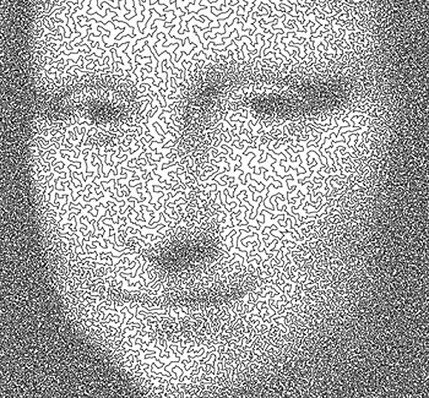
There's even TSP art. Check this out as well. Let's give O.R. and humans some credit please!
Yet, article after article that seem to come out every couple of years assumes that if a problem is NP-Hard, then it is almost "impossible to solve efficiently in practice" and enumeration is the only way. Nope. A pure application of software programming and hardware strategies certainly does not work or scale. OR leads the way.
An incredible amount of success in OR practice has come via successfully tackling precisely such large-scale and ultra-complex NP-Hard problems. Large-scale TSP-structured problems have been routinely solved in Supply-chain planning, vehicle routing, aircraft routing, etc. Not only are problems solved well and quickly, but we also know how well and how much improvement is still possible. These small optimality gaps matter. A TSP solution that is 1% closer to optimality may save a company another million dollars.
Heuristics of unknown quality based on bees and ants are nice, but they don't really tell you if there is another solution that could your save your company another 10%. And if you were to change your input parameters, it may return an entirely different solution that makes such approaches largely unpractical for use within products. And adding a constraint the prohibits certain paths may well make such approaches useless. This Tab has discussed the practical problems with using such heuristics in previous posts here, and you will find more in Dr. Trick's OR Blog when TSP was "solved" last year by creatures with even smaller brains, i.e. bacteria :-)
There's even TSP art. Check this out as well. Let's give O.R. and humans some credit please!
Saturday, October 23, 2010
Maximizing Dignity: The Traveling Angel Problem
Can one person feed 400 hungry mouths in the temple city of Madurai in South India, every day of the year?
Mr. Krishnan is a good human being. In today's world, we have to start looking for those first before we start looking for heroes. I was happy to see that he was nominated for the "CNN hero of the year" award for this work. Hopefully this publicity will translate into more help for his operation. The talented Mr. K, at the age of 22, was all set to be a five-star chef in Switzerland seven years ago, but chucked all that when he saw an hungry old man in his home town doing the unthinkable. Since then, without taking a single day off, he is up at 4am to cook tasty and fresh vegetarian food. He then drives around the town of Madurai (most famous for it's amazing Meenakshi Amman Kovil - the temple of a 1000 pillars) feeding the destitute and the hungry. He often hand-feeds them and gives them haircuts along with a meal. His focus is on restoring the dignity of a human being. Is that not fundamental? Simply put, in this temple city, Krishnan is the Goddess Annapoorani to these castaway people. Contribute generously to the Sakthi foundation's Askhaya trust if you can (paypal accepted too. cool). Even a small amount goes a long way.
O.R. is the far less important part here, but one wonders how this amazing person chooses his 125 mile driving route? He has a limited quantity of freshly prepared food stocked in his van that has to reach 400 desperately hungry mouths all over his city as effectively and efficiently as possible. OR should be helping in such practical situations. We can't always be for and about profit-maximization models for corporations, weapons and target acquisition for the military, or abstract academic problems. The logistics of Mr. K's 'meals on wheels' operation contains a classical vehicle routing / traveling salesman problem element. A more efficient operation and utilization of scarce resources means that more people can be fed and more shattered lives can rebuilt and dignity restored. The google map of the city of Madurai is shown below.
View Larger Map
Who will optimize Krishnan's supply chain?
Mr. Krishnan is a good human being. In today's world, we have to start looking for those first before we start looking for heroes. I was happy to see that he was nominated for the "CNN hero of the year" award for this work. Hopefully this publicity will translate into more help for his operation. The talented Mr. K, at the age of 22, was all set to be a five-star chef in Switzerland seven years ago, but chucked all that when he saw an hungry old man in his home town doing the unthinkable. Since then, without taking a single day off, he is up at 4am to cook tasty and fresh vegetarian food. He then drives around the town of Madurai (most famous for it's amazing Meenakshi Amman Kovil - the temple of a 1000 pillars) feeding the destitute and the hungry. He often hand-feeds them and gives them haircuts along with a meal. His focus is on restoring the dignity of a human being. Is that not fundamental? Simply put, in this temple city, Krishnan is the Goddess Annapoorani to these castaway people. Contribute generously to the Sakthi foundation's Askhaya trust if you can (paypal accepted too. cool). Even a small amount goes a long way.
O.R. is the far less important part here, but one wonders how this amazing person chooses his 125 mile driving route? He has a limited quantity of freshly prepared food stocked in his van that has to reach 400 desperately hungry mouths all over his city as effectively and efficiently as possible. OR should be helping in such practical situations. We can't always be for and about profit-maximization models for corporations, weapons and target acquisition for the military, or abstract academic problems. The logistics of Mr. K's 'meals on wheels' operation contains a classical vehicle routing / traveling salesman problem element. A more efficient operation and utilization of scarce resources means that more people can be fed and more shattered lives can rebuilt and dignity restored. The google map of the city of Madurai is shown below.
View Larger Map
Who will optimize Krishnan's supply chain?
Monday, October 18, 2010
Chakravala - Decision Analytics in Ancient India
More than two thousand years ago, many priests in India had to double up as mathematicians. They practiced the Sanathana Dharma, 'the eternal way of ethical living' (or Hinduism as it is popularly known today). Hinduism is richly influenced by nature, as well as the earthly and celestial elements, and fire rituals were quite important in those times. Careful attention was paid to the geometry of the altar, since different shapes were required depending on the objective of the ritual. This naturally gave rise to analytics, and a 'textbook' in those days (800-200 BCE) was the 'Sulba Sutras' to help figure out the correct angles and lengths to optimally design them (that lead to the discovery of Pythagorean triples and trigonometry, among other things). Inevitably, the beautiful natural patterns inherent in numbers awoke the inner geek in some of these priests.
Among the many famous mathematicians who carried forward this rich Vedic tradition was an astronomer named Brahmagupta (~ 600 CE). He extensively explored solutions to linear Diophantine equations that are central to integer programming today. Of course, his bigger distinction is for 'much ado about nothing'. He is known to be the first human being to clearly define, publish, and use zero as a number! He also explored Diophantine equations of the second degree, and came up with ideas that led to a recursive, iterative solution method for such equations; again something that is very useful in modern numerical optimization. He generalized an idea discovered by Diophantus and used this to achieve some success in finding solutions to Pell's equation. This was generalized to the Chakravala (Sanskrit for 'cyclic') algorithm by Jayadeva (950CE) and Bhaskara II (1100CE). A key subroutine at an iteration involves a neat rational scaling operation, followed by the solving of a simple discrete optimization problem that finds an integer m, such that it minimizes |m2 − N|/k, where N and k are input parameters. Furthermore, they recognize that such problems have degenerate solutions, and in some cases, find minimal integer feasible solutions using this approach. This attention to detail toward handling numerical issues stands out. Recognizing and tackling degeneracy is at the very heart of modern decision-analytics practice!
The Chakravala turns out to be an easy-to-use iterative method to find good approximations for square roots of integers. Indeed, this approach has been recognized for its ingenuity and 'careful simplicity' that allows us to work with well-conditioned real numbers; ideas that we in the OR community know are critical to matrix refactoring within a successful dual simplex implementation, for example.
Among the many famous mathematicians who carried forward this rich Vedic tradition was an astronomer named Brahmagupta (~ 600 CE). He extensively explored solutions to linear Diophantine equations that are central to integer programming today. Of course, his bigger distinction is for 'much ado about nothing'. He is known to be the first human being to clearly define, publish, and use zero as a number! He also explored Diophantine equations of the second degree, and came up with ideas that led to a recursive, iterative solution method for such equations; again something that is very useful in modern numerical optimization. He generalized an idea discovered by Diophantus and used this to achieve some success in finding solutions to Pell's equation. This was generalized to the Chakravala (Sanskrit for 'cyclic') algorithm by Jayadeva (950CE) and Bhaskara II (1100CE). A key subroutine at an iteration involves a neat rational scaling operation, followed by the solving of a simple discrete optimization problem that finds an integer m, such that it minimizes |m2 − N|/k, where N and k are input parameters. Furthermore, they recognize that such problems have degenerate solutions, and in some cases, find minimal integer feasible solutions using this approach. This attention to detail toward handling numerical issues stands out. Recognizing and tackling degeneracy is at the very heart of modern decision-analytics practice!
The Chakravala turns out to be an easy-to-use iterative method to find good approximations for square roots of integers. Indeed, this approach has been recognized for its ingenuity and 'careful simplicity' that allows us to work with well-conditioned real numbers; ideas that we in the OR community know are critical to matrix refactoring within a successful dual simplex implementation, for example.
Tuesday, October 12, 2010
Popular Mechanics and the Frankenstein design principle
Popular Mechanics is a favorite magazine for the sheer variety of mechanical gizmos it throws up inside its pages (check out the Jaguar supercar). It is a permanent fixture in many auto-service shop waiting rooms where we spend a good part of a lifetime. The October 2010 issue of Popular Mechanics was a pleasant surprise - not one but two OR-related topics were covered. The first one was a short article on optimizing waiting experience in queues. The metriclastic US population (is that a new word?) that shuns neat divisions by 10, rightly resents having to spell Q using 5 letters, one of which is Q, and simply calls it a 'line'. On the other hand, 'line theory' is not too informative. Pop-mech doesn't mention OR explicitly, but we know that queuing theory and OR are inseparable.
The queuing article (online version here), among other things, mentions that a smart researcher in Taiwan, Pen-Yuan Liao, derived an equation to compute a 'Balking Index' that tells you when and how many customers are likely to flee a long line and 'defect' to a better one in a multi-Q system. Obviously, information like this helps determine optimal staffing levels to meet the required service levels, minimize costs, and improve the customer experience. Apart from just analyzing people standing in line, queuing models have many and diverse applications and is a whole field of study. There's also some expert comments in the magazine article by Dr. Richard Larson from MIT. His name would be familiar to the OR fraternity.
The second article talks about risk management in the context of the Gulf-Coast oil spill. This tab's summary of the article from an OR perspective is this: When it comes to designing and operating complex systems, there needs to be a greater emphasis on managing conditional expectations associated with low-probability high-consequence events. This is in addition to tracking traditional risk metrics (minimizing expected cost, probability of failure, etc), i.e. we should be tracking multiple risk objectives, something i recall working on many years ago as a grad student.
The Frankenstein principle
Dr. Petroski, a civil engineering professor at the Duke University quotes in the article, "When you have a a robust system, you tend to relax". And it's proven to be true, sadly. BP continually pushed the risk-envelope to boost profits without paying adequate attention to the associated safety trade-off. In part, this was due to a false sense of safety in a historically robust system. There's always a first time, and shockingly, there was no plan 'B' in the event of a catastrophic failure. Bhopal, Chernobyl, Gulf coast and a few more like these have occurred in just the last 30 years. BP engineers were left having to prove that components would fail rather than answer the question "is it safe to operate?" - two completely different propositions. This practice of hastening project completion by placing an unfair burden of proof on the scientists and engineers may be widespread.
The Frankenstein design principle extends Murphy's law. It simply states that if for some crazy reason, you want to build something monstrously complex, then at least design it assuming apriori that at some point it will fall apart and come back to snack on your aposteriori.
The queuing article (online version here), among other things, mentions that a smart researcher in Taiwan, Pen-Yuan Liao, derived an equation to compute a 'Balking Index' that tells you when and how many customers are likely to flee a long line and 'defect' to a better one in a multi-Q system. Obviously, information like this helps determine optimal staffing levels to meet the required service levels, minimize costs, and improve the customer experience. Apart from just analyzing people standing in line, queuing models have many and diverse applications and is a whole field of study. There's also some expert comments in the magazine article by Dr. Richard Larson from MIT. His name would be familiar to the OR fraternity.
The second article talks about risk management in the context of the Gulf-Coast oil spill. This tab's summary of the article from an OR perspective is this: When it comes to designing and operating complex systems, there needs to be a greater emphasis on managing conditional expectations associated with low-probability high-consequence events. This is in addition to tracking traditional risk metrics (minimizing expected cost, probability of failure, etc), i.e. we should be tracking multiple risk objectives, something i recall working on many years ago as a grad student.
The Frankenstein principle
Dr. Petroski, a civil engineering professor at the Duke University quotes in the article, "When you have a a robust system, you tend to relax". And it's proven to be true, sadly. BP continually pushed the risk-envelope to boost profits without paying adequate attention to the associated safety trade-off. In part, this was due to a false sense of safety in a historically robust system. There's always a first time, and shockingly, there was no plan 'B' in the event of a catastrophic failure. Bhopal, Chernobyl, Gulf coast and a few more like these have occurred in just the last 30 years. BP engineers were left having to prove that components would fail rather than answer the question "is it safe to operate?" - two completely different propositions. This practice of hastening project completion by placing an unfair burden of proof on the scientists and engineers may be widespread.
The Frankenstein design principle extends Murphy's law. It simply states that if for some crazy reason, you want to build something monstrously complex, then at least design it assuming apriori that at some point it will fall apart and come back to snack on your aposteriori.
Wednesday, October 6, 2010
Video analysis - followup to previous post on "Should Steve Smith have gone for the run-out?"
Updated Oct 7: youtube video.
As can be seen from the video footage of the last few minutes of the test match, Steve Smith came incredibly close to settling the issue by taking the initiative in a moment of cricketing chaos. He was fielding at point, and fired in the throw at a pretty acute angle - a bold gamble. He brushed against legend but it ended up being India's greatest sporting victory. Another great article by Australian sports writer Peter Roebuck, can be read here.
As can be seen from the video footage of the last few minutes of the test match, Steve Smith came incredibly close to settling the issue by taking the initiative in a moment of cricketing chaos. He was fielding at point, and fired in the throw at a pretty acute angle - a bold gamble. He brushed against legend but it ended up being India's greatest sporting victory. Another great article by Australian sports writer Peter Roebuck, can be read here.
Tuesday, October 5, 2010
OR and cricket: Should Steve Smith have gone for the run-out? - India versus Australia, 2010
Nearly a year ago, the mathletics blog of Dr. Wayne Winston has an interesting analysis of whether Pats coach Bellicheck should have gone for it on a critical 4th down, and put the coach's decision down to his confidence in Tom Brady. Yesterday, some thing similar (but far more serious) happened on the last day (D5) of one of the greatest test cricket matches in history.
The result
Check out the amazing scorecard. In the 120-year history of test cricket, there have been only 12 such finishes.
The match situation
It is day 5 of the contest. About 26 hours of play time has passed and we are into the bottom of the 4th and final innings. India is batting and has lost 9 of their 10 wickets on a wicked last-day pitch with widening cracks and the ball spitting off the pitch. Many have gotten out to bouncers. Just an hour ago, India was down and out having lost 8 wickets with 92 runs still to get. A remarkable partnership between two injured players brings the match to a screaming knife edge. Australia requires 1 wicket to win. India needs 6 runs. At the crease is the injured Indian genius VVS Laxman overcoming back spasms with painkillers and with sheer grit, he is attempting to steal a miraculous win. But the one who is taking strike is P Ojha, a spin-bowler and India's no.11 player, who can't really bat. Bowling is Australian fast bowler Mitchell Johnson who can bowl past speeds of 95mph (there are others who can crank it up to 100mph).
The event
Here's cricinfo's description of the third-from-last ball of the match (edited version here):
Johnson to Ojha, 4 runs, 90.5 mph, Lbw Shout And oh boy what we get .. Four Over throws! That looked out. Was there some wood on leather? Oh well ... What an insane little game this is! .. Steve Smith fires the throw and the ball misses the stumps and runs through the vacant covers. No Aussie fielder could back that up. But that throw was on. Had he hit - and he didn't miss by much - Ojha would have been run out. .....
(india wins 2 balls later)
Post-mortem
Many cricket fans have criticized Steve Smith's decision to take a shy at the stumps. The Australian captain himself felt it was the right call and praised the rookie. If he had hit the wicket it would have been match over. Indeed several sports writers have called it a gutsy and worthy call. I know that if it was an Indian fielder instead, he would have been roasted by India's trigger-happy media.
Probability Model
Probability that australia wins = A. Probability that India wins = 1-A.
There are two scenarios:
1. If successful hit (probability p), then match over, australia win with probability 1.
2. If miss (probability 1-p) then there are two sub-outcomes:
2a. if fielder backing up, no overthrows, and australia win again with probability A (reset).
2b. if no protection, then overthrows, and australia win with probability A' < a =" p(1-A)"> A.
If (2b) is given:
p(win given hit) = p + (1-p)A'
This is statistically a good decision provided p + (1-p)A' >= A. A simple condition where this holds true would be if he were such a good fielder that statitically he hits the wicket more than 100A % of the time, i.e. if he felt that his chance of hitting the wicket was at least as good as the chance that Australia currently has of winning the game (fixing p = A would result in the LHS being > A)
Let's play with some numbers
1. Let's assume that with every run scored, the chance of success for Australia proportionally drops, so the cost of each overthrow run is A/6. For a worst-case 4 overthrows, this gives A' = A-4A/6 = A/3
2. so steve's accuracy rate had to satisfy:
p(1-A/3) >= 2A/3, or p >= 2A/(3-A)
3. If we assume that with just a single wicket to get, but only 6 runs to score, its anybody's game, and set A= 0.5. then steve's accuracy rate had to be atleast 1/2.5.
4. On the other hand, if you start with the premise that A is lower, say 25%, then steve only required an 18% accuracy to justify the throw. In other words, if you perceive that you have little chance of winning, then it is certainly a great idea to take the risk.
Modeling Ideas
You can also calculate 'A' in a more sophisticated manner by looking at the competing counting process to determine P(wicket falls before 6 runs are scored). The probability that a wicket falls in some 'n' balls is a geometric distribution. Each ball is a Bernoulli trial. The distribution of runs per ball could be Poisson. India scored 6 runs in the previous 3 overs (18 balls), so purely statistically, you can extrapolate that to say there's about 18 balls to get the last wicket. All said and done, a 50-50 chance is the most practical choice for 'A' here.
Conclusion
If Steve Smith was generally able to hit the stumps 40% of the time (i.e. slightly less than even chance), then it would have a good call from a statistical point of view. I haven't gotten a chance to review to video to see if it was an easy versus difficult angle to hit the wicket, but on average, 40% does look like a fairly high required conversion rate.
Statistically it was not a great call especially if he knew there was nobody to back up. All the pressure previously built up on the batsman was released. But cricket is played on the field and making a match-defining split-second decision after 26 hours of exhilarating play is no easy ask. No guts, no glory. It's the Aussie way and the glorious game of cricket is better off with that choice, (especially since India won :-)
The result
Check out the amazing scorecard. In the 120-year history of test cricket, there have been only 12 such finishes.
The match situation
It is day 5 of the contest. About 26 hours of play time has passed and we are into the bottom of the 4th and final innings. India is batting and has lost 9 of their 10 wickets on a wicked last-day pitch with widening cracks and the ball spitting off the pitch. Many have gotten out to bouncers. Just an hour ago, India was down and out having lost 8 wickets with 92 runs still to get. A remarkable partnership between two injured players brings the match to a screaming knife edge. Australia requires 1 wicket to win. India needs 6 runs. At the crease is the injured Indian genius VVS Laxman overcoming back spasms with painkillers and with sheer grit, he is attempting to steal a miraculous win. But the one who is taking strike is P Ojha, a spin-bowler and India's no.11 player, who can't really bat. Bowling is Australian fast bowler Mitchell Johnson who can bowl past speeds of 95mph (there are others who can crank it up to 100mph).
The event
Here's cricinfo's description of the third-from-last ball of the match (edited version here):
Johnson to Ojha, 4 runs, 90.5 mph, Lbw Shout And oh boy what we get .. Four Over throws! That looked out. Was there some wood on leather? Oh well ... What an insane little game this is! .. Steve Smith fires the throw and the ball misses the stumps and runs through the vacant covers. No Aussie fielder could back that up. But that throw was on. Had he hit - and he didn't miss by much - Ojha would have been run out. .....
(india wins 2 balls later)
Post-mortem
Many cricket fans have criticized Steve Smith's decision to take a shy at the stumps. The Australian captain himself felt it was the right call and praised the rookie. If he had hit the wicket it would have been match over. Indeed several sports writers have called it a gutsy and worthy call. I know that if it was an Indian fielder instead, he would have been roasted by India's trigger-happy media.
Probability Model
Probability that australia wins = A. Probability that India wins = 1-A.
There are two scenarios:
1. If successful hit (probability p), then match over, australia win with probability 1.
2. If miss (probability 1-p) then there are two sub-outcomes:
2a. if fielder backing up, no overthrows, and australia win again with probability A (reset).
2b. if no protection, then overthrows, and australia win with probability A' < a =" p(1-A)"> A.
If (2b) is given:
p(win given hit) = p + (1-p)A'
This is statistically a good decision provided p + (1-p)A' >= A. A simple condition where this holds true would be if he were such a good fielder that statitically he hits the wicket more than 100A % of the time, i.e. if he felt that his chance of hitting the wicket was at least as good as the chance that Australia currently has of winning the game (fixing p = A would result in the LHS being > A)
Let's play with some numbers
1. Let's assume that with every run scored, the chance of success for Australia proportionally drops, so the cost of each overthrow run is A/6. For a worst-case 4 overthrows, this gives A' = A-4A/6 = A/3
2. so steve's accuracy rate had to satisfy:
p(1-A/3) >= 2A/3, or p >= 2A/(3-A)
3. If we assume that with just a single wicket to get, but only 6 runs to score, its anybody's game, and set A= 0.5. then steve's accuracy rate had to be atleast 1/2.5.
4. On the other hand, if you start with the premise that A is lower, say 25%, then steve only required an 18% accuracy to justify the throw. In other words, if you perceive that you have little chance of winning, then it is certainly a great idea to take the risk.
Modeling Ideas
You can also calculate 'A' in a more sophisticated manner by looking at the competing counting process to determine P(wicket falls before 6 runs are scored). The probability that a wicket falls in some 'n' balls is a geometric distribution. Each ball is a Bernoulli trial. The distribution of runs per ball could be Poisson. India scored 6 runs in the previous 3 overs (18 balls), so purely statistically, you can extrapolate that to say there's about 18 balls to get the last wicket. All said and done, a 50-50 chance is the most practical choice for 'A' here.
Conclusion
If Steve Smith was generally able to hit the stumps 40% of the time (i.e. slightly less than even chance), then it would have a good call from a statistical point of view. I haven't gotten a chance to review to video to see if it was an easy versus difficult angle to hit the wicket, but on average, 40% does look like a fairly high required conversion rate.
Statistically it was not a great call especially if he knew there was nobody to back up. All the pressure previously built up on the batsman was released. But cricket is played on the field and making a match-defining split-second decision after 26 hours of exhilarating play is no easy ask. No guts, no glory. It's the Aussie way and the glorious game of cricket is better off with that choice, (especially since India won :-)
Monday, October 4, 2010
Is this umbrella optimally designed?
Building retail pricing products for a living, i spend an inordinate amount of time analyzing online deals. And you get to see lots of innovative new gizmos on sale. The umbrella shown in the video below was on sale and caught my attention.
It was introduced in the market a couple of years ago and has won multiple design awards. It's aerodynamic and looks like a bicycle helmet extended into an umbrella. I checked out the wind tunnel tests - impressive. It doesn't turn inside out. It's got an eye-protective design built-in and also provides better frontal vision. If you are a geek, you'd feel that you would never want to be caught under the old dome again. It is well-marketed. Check out these product stress test videos. I mean the 300 Spartans could have survived using the Senz as a shield.
Let's apply some practical OR tests.
First look at the actual human feedback at Amazon.com. There aren't too many data points sadly. Some like it and some don't. Next we look at the analytics hidden inside the design of the umbrella. We also examine its external functionality. A really nice analytical innovation allows the umbrella to not fight the wind but mildly orient itself along the path of least resistance. Several stress tests empirically prove this.
Conclusion: Handles wind really well and better vision, so you don't feel like you are in a tent.
However, there's something missing in these tests. Let us turn to robust optimization analysis. All the talk is about gale force winds, wind tunnels. etc. What about some simple vertical rain at terminal velocity? How would it perform in Cherrapunji, India or the town of Mawsynram in the nearby Indian state of Meghalaya, which received 1000 inches of rain in 1985. How does it handle those good old pesky, incessant drizzles?How about sleet and randomized rain loads? How about the inevitable sidewalk drenching from the tires of a car on a wet road?
Conclusion - It appears that it is does not perform the basic, everyday function of an "umbrella for a rainy day" as robustly as it tackles wind. There are a couple of feedbacks in Amazon which highlight this basic limitation.
Question: In a randomized rain situation, can i run in a straight line with an aerodynamic umbrella like the Senz to introduce a favorable directional bias in the forces and improve its rain-performance?
Note that when it is steadily raining, and without an umbrella of any kind, the amount of water that your body/dress absorbs is practically the same, whether u walk or run to cover a fixed distance.
In many places in the world, people regularly use an umbrella to block out the hot sun. Since the total area is relatively smaller when compared to the traditional umbrella, it covers less.
Conclusion: less protection against the sun.
Finally, the most interesting comment was a person who said two people couldn't fit under this umbrella. It's going to be a disastrous end to a date when your partner is under your aerodynamic umbrella and getting all wet in the rain.
Final conclusion: The old dome is on average, more robust for most normal rain/sun/slush situations, and is much less expensive. The inner geek will compel you to get a Senz for the cool wind analytics. Or if you are some weather channel tv journo who shows up in hurricane/tornado hit areas. But guys, don't take the Senz with your girlfriend on a rainy day, and certainly not your wife (and most certainly not both - under any umbrella. sorry, couldn't resist).
It was introduced in the market a couple of years ago and has won multiple design awards. It's aerodynamic and looks like a bicycle helmet extended into an umbrella. I checked out the wind tunnel tests - impressive. It doesn't turn inside out. It's got an eye-protective design built-in and also provides better frontal vision. If you are a geek, you'd feel that you would never want to be caught under the old dome again. It is well-marketed. Check out these product stress test videos. I mean the 300 Spartans could have survived using the Senz as a shield.
Let's apply some practical OR tests.
First look at the actual human feedback at Amazon.com. There aren't too many data points sadly. Some like it and some don't. Next we look at the analytics hidden inside the design of the umbrella. We also examine its external functionality. A really nice analytical innovation allows the umbrella to not fight the wind but mildly orient itself along the path of least resistance. Several stress tests empirically prove this.
Conclusion: Handles wind really well and better vision, so you don't feel like you are in a tent.
However, there's something missing in these tests. Let us turn to robust optimization analysis. All the talk is about gale force winds, wind tunnels. etc. What about some simple vertical rain at terminal velocity? How would it perform in Cherrapunji, India or the town of Mawsynram in the nearby Indian state of Meghalaya, which received 1000 inches of rain in 1985. How does it handle those good old pesky, incessant drizzles?How about sleet and randomized rain loads? How about the inevitable sidewalk drenching from the tires of a car on a wet road?
Conclusion - It appears that it is does not perform the basic, everyday function of an "umbrella for a rainy day" as robustly as it tackles wind. There are a couple of feedbacks in Amazon which highlight this basic limitation.
Question: In a randomized rain situation, can i run in a straight line with an aerodynamic umbrella like the Senz to introduce a favorable directional bias in the forces and improve its rain-performance?
Note that when it is steadily raining, and without an umbrella of any kind, the amount of water that your body/dress absorbs is practically the same, whether u walk or run to cover a fixed distance.
In many places in the world, people regularly use an umbrella to block out the hot sun. Since the total area is relatively smaller when compared to the traditional umbrella, it covers less.
Conclusion: less protection against the sun.
Finally, the most interesting comment was a person who said two people couldn't fit under this umbrella. It's going to be a disastrous end to a date when your partner is under your aerodynamic umbrella and getting all wet in the rain.
Final conclusion: The old dome is on average, more robust for most normal rain/sun/slush situations, and is much less expensive. The inner geek will compel you to get a Senz for the cool wind analytics. Or if you are some weather channel tv journo who shows up in hurricane/tornado hit areas. But guys, don't take the Senz with your girlfriend on a rainy day, and certainly not your wife (and most certainly not both - under any umbrella. sorry, couldn't resist).
Thursday, August 26, 2010
OR Theory, as opposed to OR Practice
An interesting exchange at where else but OR-exchange on "will OR take over the world" ? I would suggest a read-up there and to post your views to keep the discussion going. As one of the participants, a suggestion was made that OR has gone well beyond its mandate and overtaken the world (which gives me a convenient excuse to link to the good old pomo generator. We should build an OR-theory version some time :-), and that there was a crying need to get back to Terra firma.
Sadly, OR practice has very little to do with OR theory now-a-days. It doesn't matter if the department is part of the school of engineering, humanities, or management. Yes, theory has its place. OR theory is particularly enchanting, but an equal part of OR-academia has to be about training kids to think about practical solutions for the real world today, where OR enables a better understanding of real problems for real human beings. This balance is skewed today.
In short, academic OR (today) is almost all about answers, but in OR practice, the 'value-add' comes from asking the right questions. Given the right question, finding a good prescriptive answer in practice is, relatively speaking, a piece of cake (NP-Hard or not, bleeding-edge solver or not). Going to the customer and saying they have an unsolvable problem scenario because the solver that sliced thru your complex MIP model said it was 'infeasible' is just not done. Playing the good OR guy and walking your customer through a well-intentioned slide slow of analyzing an irreducible inconsistent subsystem to explain it is not much better. All that we have done so far is show how ineffective our efforts has been so far! After all, the customer was in business for decades without OR and did pretty well. So a first step in OR practice is to somehow get the customer to tutor us on how they optimized their business well enough to feed their families in this world (when we were happily experimenting with n-dimensional representations in hyperspace until our advisor kicked us out of school with a PhD), so we at least don't make a complete fool of ourselves. A second step would be to apply common sense, but then OR programs rarely get ranked and papers seldom get accepted based on such uncool stuff.
Sadly, OR practice has very little to do with OR theory now-a-days. It doesn't matter if the department is part of the school of engineering, humanities, or management. Yes, theory has its place. OR theory is particularly enchanting, but an equal part of OR-academia has to be about training kids to think about practical solutions for the real world today, where OR enables a better understanding of real problems for real human beings. This balance is skewed today.
In short, academic OR (today) is almost all about answers, but in OR practice, the 'value-add' comes from asking the right questions. Given the right question, finding a good prescriptive answer in practice is, relatively speaking, a piece of cake (NP-Hard or not, bleeding-edge solver or not). Going to the customer and saying they have an unsolvable problem scenario because the solver that sliced thru your complex MIP model said it was 'infeasible' is just not done. Playing the good OR guy and walking your customer through a well-intentioned slide slow of analyzing an irreducible inconsistent subsystem to explain it is not much better. All that we have done so far is show how ineffective our efforts has been so far! After all, the customer was in business for decades without OR and did pretty well. So a first step in OR practice is to somehow get the customer to tutor us on how they optimized their business well enough to feed their families in this world (when we were happily experimenting with n-dimensional representations in hyperspace until our advisor kicked us out of school with a PhD), so we at least don't make a complete fool of ourselves. A second step would be to apply common sense, but then OR programs rarely get ranked and papers seldom get accepted based on such uncool stuff.
Subscribe to:
Posts (Atom)